

 Facebook
 Twitter
 LinkedIn
 Email
EmailWelcome to Signal & Trust, a new monthly briefing from Aspen Digital on AI and how it’s reshaping the news and information landscape. We’ll feature key voices across media, technology, government, and civil society and curate the most interesting news. Check out our first edition below and give us your feedback. If you like what you see please subscribe, and share with your friends and colleagues!
– Vivian Schiller, Vice President & Executive Director of Aspen Digital (a program of the Aspen Institute)
In this issue
- The Price of News: As AI companies ingest news content at scale, will the future be governed by courtroom decisions or licensing frameworks?
- The Guardian’s Strategy: CEO Anna Bateson tells Aspen Digital how the world’s largest reader-funded news organization is navigating AI and why “copilot not autopilot” guides their approach.
- Scanning for Signals: Our curated round-up of AI, news and trust stories that reveal deeper trends the sector will be watching in 2026.
Sign-up to receive future issues in your inbox 👉 Subscribe here
The big picture
The strategic question every publisher is wrestling with right now
Who Sets the Price of News in the AI Era?
As AI companies ingest journalism at scale, a defining question emerges: Will the future of news be governed by courtroom victories or market-based licensing frameworks—and who gets to set the terms? With a trial date looming in 2026, the New York Times v. OpenAI/Microsoft case is often treated as the story, but it’s really a proxy battle for something much larger: whether journalism should be licensed for AI systems, or free raw material up for grabs by the models.
❓Why This Matters Now – What happens next won’t just affect legacy publishers and Big Tech. It will determine whether licensing becomes a sustainable revenue model for news organizations of all sizes—or whether compensation remains opaque and tilted toward those with the most leverage.
📣 What’s Actually Happening – Four scenarios are emerging:
- Litigation as leverage: Major publishers (NYT, Ziff Davis, others) are pushing courts to clarify whether large-scale AI training is fair use or infringement, betting that a win resets bargaining power across the industry.
- Licensing as pragmatism: Others (AP, Axel Springer, Le Monde) are striking deals now, trading near-term certainty for the risk of weaker long-term precedents.
- Litigation and licensing as a hedge: Many publishers are pursuing a dual-track strategy by cutting selective licensing deals with AI companies while keeping lawsuits in play to manage uncertainty. The goal isn’t to pick a winner yet, but to preserve leverage and optionality.
- A fragmented middle: Most publishers—especially local and nonprofit outlets—lack the resources to sue or the leverage to negotiate meaningful deals. They’re operating in a gray zone, exposed to both AI training scrapes and platform dependency, with few tools to protect their work.
📰 The Stakes for Newsrooms:
- Negotiating power: A court win could lift all boats; a loss could result in a permanently uneven playing field, with medium and small media companies lacking the financial and legal heft to protect themselves.
- Revenue durability: Licensing could become a real second revenue stream, or just a symbolic one.
- Strategic positioning: Newsrooms must decide whether to fight, deal, block—or pursue some combination—and on what timeline.
🔍 What To Watch Next:
- Early judicial signals that hint at how courts define “transformative use” for AI training—i.e., whether training models on news content is legally viewed as creating something new, or as repackaging and monetizing the underlying journalism without consent.
- Whether licensing terms begin to converge, or remain one-off and behind-closed-doors.
- The emergence of collective licensing efforts or industry-backed exchanges.
- The first major publisher to fully revoke AI crawler access as a negotiating tactic.
🔎 TRACK THE BATTLE: For an up-to-date view of publisher lawsuits, licensing deals, and emerging precedents, see the Columbia University Tow Center for Digital Journalism’s AI Deals & Disputes Tracker.
signal scan
A curated round-up of how AI is reshaping news – and trust
Google IP boss: We shouldn’t pay for AI training on ‘freely available’ content
A senior Google executive told UK lawmakers the company should not have to license “freely available” web content for AI training, while declining to address news publishers inability to opt out of AI overviews without losing search visibility.
Source: Press Gazette
Journalism, Media, and Technology Trends and Predictions 2026
The Reuters Institute’s 2026 Trends report reveals a strategic pivot: as AI overviews erode referral traffic, publishers plan to scale back on service journalism and evergreen content in favor of on-the-ground reporting, investigations and video formats AI can’t easily generate.
Source: Reuters Institute
Global AI Policy is Being Written – But Mostly Without Journalism in Mind
A new analysis for the Center for News, Technology & Innovation reviewed 188 national and regional AI strategies, laws and policies worldwide and found that only 20 explicitly mention journalism.
From Browsing to Asking: Ten Shifts Reshaping Media in 2026
Ezra Eeeman, who leads strategy and innovation at NPO (Dutch public broadcasting), maps ten converging shifts reshaping media in 2026, from the “lazy web,” where browsing gives way to asking, to the “trust inversion,” where more AI-generated content produces less credibility. The throughline: familiar assumptions are flipping and the question is no longer what AI can do, but what media companies chose to do with it.
2025 Year in Review: What Actually Changed for AI and News (Podcast)
Newsroom Robots host Nikita Roy talks with Francesco Marconi (AppliedXL) and Scott Austin (Symbolic.ai) about what 2025 actually changed—from the collapse of search traffic to AI agents and proactive distribution.
data point
An AI and News trend visualized
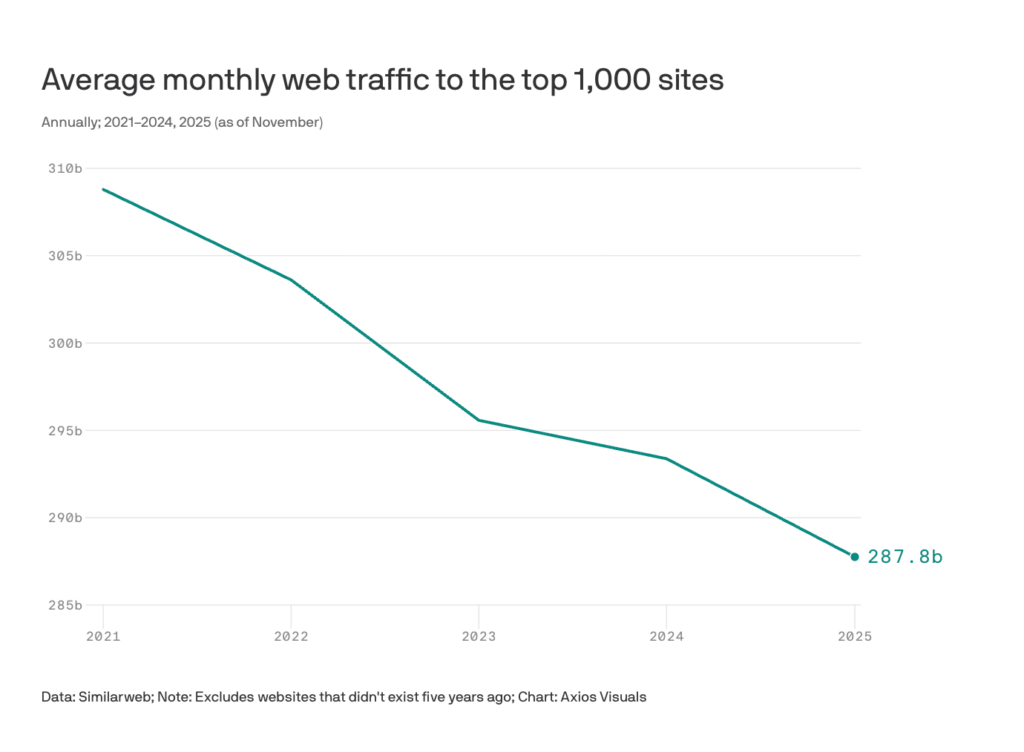
Traffic to legacy websites is in steady decline, a structural shift that AI-driven search is accelerating, not reversing. With data from Tollbit showing referrals from AI chatbots running 96% below traditional search, the new discovery channels aren’t replacing what publishers are losing.
Source: Axios
primary source
How industry leaders are thinking about AI, trust and what comes next

“We want to provide facts, context and truth, and to hold power to account. This means any personalisation has to support discovery. We design for breadth, not bubbles.”
– Anna Bateson, CEO of Guardian Media Group
In an era when generative AI is reshaping how people find and trust information, Guardian Media Group CEO Anna Bateson speaks with Aspen Digital about the Guardian’s strategy, philosophy, and future. The discussion has been edited for clarity and length.
Aspen Digital: Many in the industry see opportunity in generative AI, but also serious risks. How does the Guardian balance the benefits vs. the risks?
Anna Bateson: These tools can be useful, but they are not a substitute for human judgment. They lack the knowledge, wit and sophistication of, say, an experienced subeditor or a talented culture writer. At the Guardian, all our journalism is created by our journalists. We use AI where it can strengthen our work, improve audience experiences, or streamline the admin that gets in the way. We do not use AI where it could undermine trust. That means clear governance and accountability, detailed policies and mandatory staff training to help colleagues make safe, informed choices about using AI. For instance, we’ve established an AI Council that sets our strategic direction as the technology evolves, and a tech board that leads on decisions around responsible ways to deploy GenAI-powered tools across the organisation.
Aspen Digital: A major tension for publishers today is intellectual property. How do you view the relationship between the Guardian and the AI companies building these large models?
Anna Bateson: It’s important as an industry that we don’t repeat the mistakes from the early days of social media, where publishers were late to the conversation. These partnerships can help new audiences discover the Guardian, which matters if we want to continue growing as a global news organisation. We’ll work with AI companies when there is a strong framework of transparency and fair reward, and where we have control over how our journalism appears. At the same time, we’ve invested significant resources to protect our digital intellectual property and prevent companies from scraping our content without permission. We are open to partnerships, but we will not accept unauthorised use of our journalism.
Aspen Digital: Many publishers are exploring AI powered personalization. Where do you draw the line between enhancing relevance and creating filter bubbles that undermine the Guardian’s public interest mission?
Anna Bateson: We want to provide facts, context and truth, and to hold power to account. This means any personalisation has to support discovery. The line for us is when optimisation starts narrowing our audience’s worldview. Editorial judgement will always be our primary consideration and readers should have clear navigation controls. We design for breadth, not bubbles.
Aspen Digital: In a world where platforms may soon answer questions directly using AI, how does the Guardian ensure its journalism, and its brand, remain visible and valued?
Anna Bateson:We’ll keep doing what audiences come to us for: original, factual reporting delivered with integrity. As audience habits change, we’re always looking at how we can make sure our journalism can be found wherever they are. The Guardian has a strong track record of innovation, and we recently announced a multi-year, company-wide transformation plan to better understand how audiences are changing the way they consume and engage with news. This will help us evolve how our journalism is produced and delivered, so we can meet new and existing audiences on and off platform with the clarity, context, hope, humour and truth they expect from the Guardian.
Aspen Digital: What advice do you have for smaller news publishers in terms of how they approach AI?
Anna Bateson: Don’t start with the tool. Start with what you stand for, and look for ways that AI can be in service of that. Put strong, basic guardrails in place that everyone understands, then run small pilots to test use cases – and evaluate them honestly. Inside the Guardian, we often talk about treating AI as a copilot, not an autopilot. However you experiment with AI tools, always keep humans accountable. News brands are built on trust, so protect it fiercely.
in the feed
One share worth a closer 👀
Source: Florent Daudens, LinkedIn
dive deeper
Updates from Aspen Digital

NEW! MIND THE GAP: AI AND THE FUTURE OF NEWS IN LATIN AMERICA
As the public more and more turns to AI chatbots for news results, publishers have stepped up to differentiate their original reporting while also adopting AI tools to stay competitive. In October, 2025, Aspen Digital brought together leading voices in media and technology throughout Latin America for a convening in Buenos Aires on the side lines of the annual Media Party conference. Check out our findings in a report by Sebastián Auyanet.
¿Hablas Español? Lee el artículo completo en Español aquí.
stay in touch
Explore our full library of research and resources, and sign up for this newsletter (if not already).