

 Facebook
 Twitter
 LinkedIn
 Email
EmailThis spotlight presents the top strategies for improving access and distribution of food, including addressing barriers to transporting, marketing, or delivering food.
These findings represent survey input from 98 participants working in food security across 20 of the 22 UN Statistical Division geographical regions. In the Regional Breakdown of Results section, responses are grouped into three clusters by Human Development Index (HDI) based on the geographies of participants’ work: Less Developed Regions, More Developed Regions, or Most Developed Regions. For more information on our methodology and the full list of challenges and strategies, see the Feeding the Future main report.
Access and Distribution challenges shape multiple dimensions of food systems, from the quantity and quality of food available to the ways in which it reaches people and the stability of supply over time. Because these variables are interdependent and highly sensitive to local conditions, it is natural that participants selected a diverse set of strategies to address them; reflecting the complexity of the issue, geographic differences, and the number of foundational elements that must work together for Access and Distribution to function effectively.
Over the past decades, food production techniques have evolved substantially, yet ensuring a steady and reliable flow of food remains a persistent challenge. Technology has played an essential role in this evolution, from generating the knowledge and practices needed to preserve food safely to developing demand-forecasting tools and precision logistics that have expanded efficiency across supply chains. With current advances in data systems, cold-chain management and real-time monitoring, for example, technology has now the potential to further address this challenge by reducing disruptions and making food systems more resilient to shocks.
Overall Top Strategies for Access & Distribution
#1 Combine grants with low-interest loans and technical assistance to reduce financing risks (“blended financing”)
Emerging from efforts by institutions such as the OECD and development banks, blended finance was designed to address structural gaps that limit access to capital for underserved actors. In many contexts, improving food access depends on targeted investments, especially in last-mile infrastructure and local distribution networks. These investments are often needed in subnational jurisdictions or financially constrained countries that do not qualify for traditional credit instruments. By combining public and private resources through tools such as guarantees or concessional rates, blended finance can reduce risk and make these investments viable, enabling food to reach vulnerable or geographically dispersed populations.
#2 Promote inclusive land governance through participatory policy and legal processes
Land governance also emerges as a core issue where food security practitioners would like to see progress. Clear and predictable rules about land use and rights shape who is able to produce food and how food moves from producers to markets. When land governance is inclusive and built through participatory legal and policy processes, it can protect small producers and local communities who are often critical for supplying food to nearby populations. By contrast, high concentration of land in the hands of a few can seriously affect access, in particular by displacing small producers, reducing productive diversity and land resilience, undermining economic competition and efficiency, and intensifying social conflict.
#3 Improve early warning systems for pests, droughts, and extreme weather
Early-warning systems are a critical component of food-supply systems. Extreme weather events or pest outbreaks can disrupt access suddenly, leaving communities exposed and without immediate alternatives. Transportation infrastructure may be affected by natural disasters, fresh food supplies may be damaged by moisture or extreme heat, and droughts can dramatically change demand. Designing and implementing comprehensive early-warning mechanisms is a basic step toward mitigating these shocks through actions such as pre-positioning supplies, preparing roads, reinforcing safety measures in storage facilities, estimating critical demand, and protecting crops.
#4 Facilitate direct-to-consumer sales of fresh food through markets, cooperatives, or digital platforms
Facilitating direct to consumer sales of fresh food can improve access by reducing structural bottlenecks in food distribution and bringing supply closer to local demand. Recent evidence shows that small retailers and communities often rely on large distributors that prioritize volume and standardization, which limits the availability of fresh and locally produced food. Direct sales through markets, cooperatives, or digital platforms allow producers to sell smaller and more diverse quantities of food, while giving retailers and consumers access to fresh products that would otherwise be difficult to source. When coordination tools and shared infrastructure reduce transaction costs, these channels become economically viable at scale, improving food access while strengthening local producers rather than enriching distant supply chains.
#5 Increase public awareness of the value and positive benefits of nutritious food
Raising awareness of the positive benefits of certain foods—essentially democratizing the ability to discern food quality—can be crucial for consumers who face access constraints. Steering choices toward options that balance nutrition, rather than alternatives of similar price but lower quality, can have a meaningful impact on community wellbeing. Interestingly, while many participants chose this strategy, the complimentary strategy “increase public awareness of the harms and negative impacts of less nutritious food” was the second least-chosen strategy for this challenge. This may reflect a view that negative messaging is less effective.
Regional Breakdown of Results
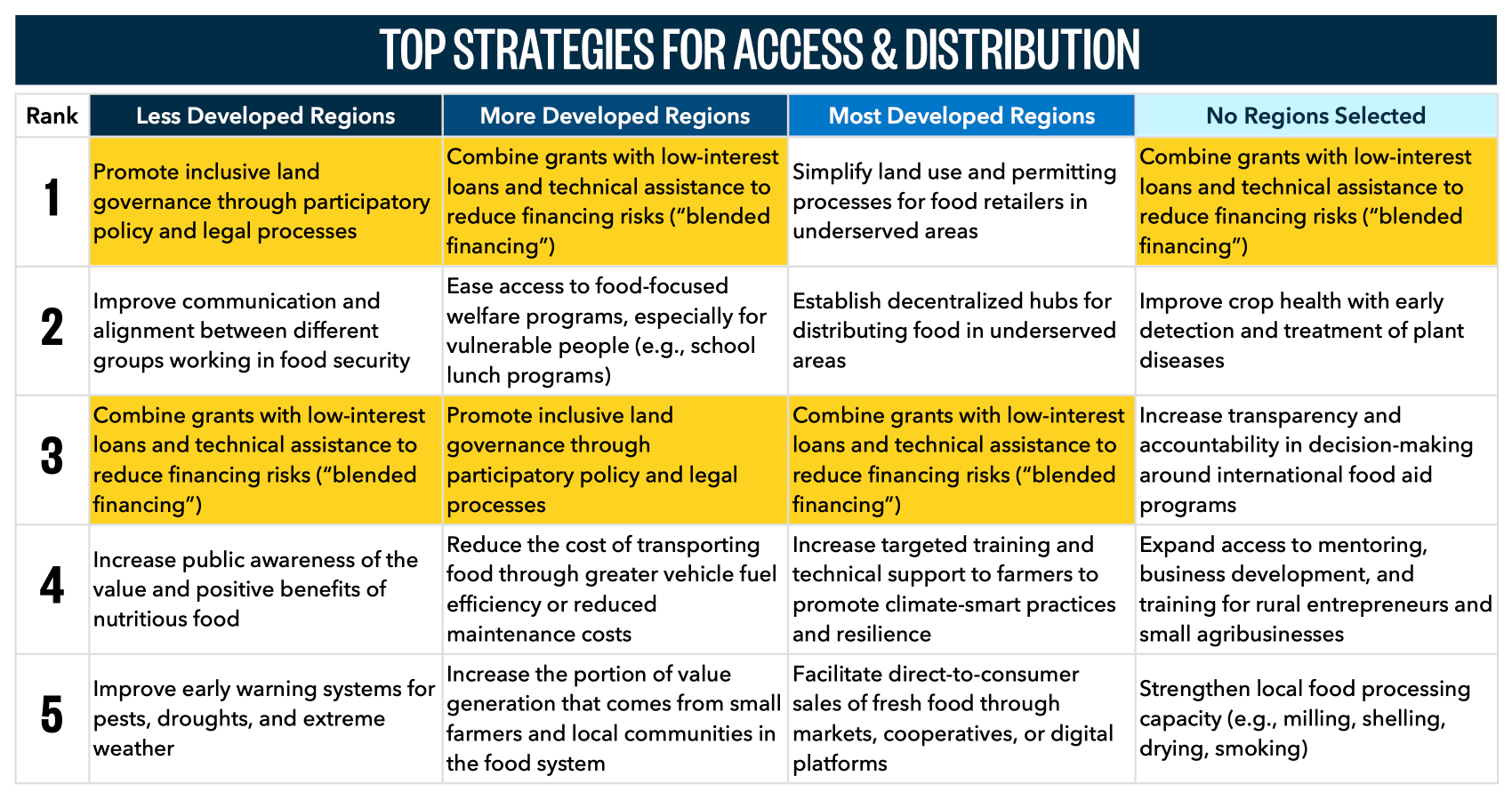
Compared to other high-level challenges in food security, Access and Distribution demonstrates the least alignment on top five priorities across the different development regions. In fact, there’s more alignment on the strategies that are not applicable (bottom 5) than those that are. This may reflect how access needs are determined by local context and how distribution infrastructure is a key factor in development level. Interestingly, many strategies that have been put forward for addressing these challenges, including mandates for fresh food stocking, were rejected by survey participants.
Feeding the Future Challenge Spotlight: Access & Distribution © 2026 by Aspen Digital is licensed under CC BY 4.0.