

 Facebook
 Twitter
 LinkedIn
 Email
EmailIssue 2 | February 2026
In this issue
- Are Publishers Missing the AI Revolution?: At the fifth annual Local News Summit, news leaders are challenged to move beyond pilots.
- Inside the American Journalism Project’s Playbook for AI: CEO Sarabeth Berman on how AJP is helping nonprofit newsrooms move from experimenting and learning to building and sharing.
- Scanning for Signals: Our curated round-up of AI and News developments, from the emergence of new content marketplaces for AI licensing to the IAB’s new push for scraping legislation.
Sign-up to receive future issues in your inbox 👉
Subscribe below
THE Big Picture
The strategic question every publisher is wrestling with right now
Is Local News at Risk of Missing the AI Revolution?
For news leaders, it’s a familiar story: the slow, halting roll toward transformation that marked the digital era may be repeating itself. A recent Reuters Institute survey found 62% of media managers cite lack of resources as the biggest barrier to innovation, with more than 40% saying their AI initiatives are showing only “limited” results. At last month’s fifth annual Local News Summit, co-hosted by the Lenfest Institute for Journalism and Aspen Digital, that tension took center stage–and produced no easy answers. (👉 See our recap and reflections about the convening.)
❓Why This Matters Now – In his opening provocation, Vilas Dhar, president of the Patrick J. McGovern Foundation, issued a blunt challenge: the industry has yet to begin its AI revolution. (👉 Read Dhar’s full provocation). By comparison, he said, the finance industry executes 70% of equity trades using algorithms. Journalism, he contends, is still running modest pilots. And while trust, accuracy, and human judgement cannot be automated like stock trades, the gap between experimentation and execution suggests journalism may be mistaking caution for inaction.
“The typical newsroom of 2025 still runs on the same roles, routines, and deadlines as 2015, with a thin veneer of AI tools at the margins… The storytellers cannot afford to sleep through the revolution happening in our midst.”
-Vilas Dhar, President of the Patrick J. McGovern Foundation
📣 What’s Actually Happening – Leaders at the summit wrestled with four key core questions.
- AI in the Newsroom: Some local newsrooms are already using AI for backend functions like payment management and geo-targeted newsletters, but adoption remains uneven. The consensus: newsrooms need their own spaces to discuss what’s working, what isn’t and what one participant called “trash AI” – tools that simply shouldn’t be used.
- AI for Product Innovation: Many are clinging to traditional formats. The home page and the article may be a dead end when audiences consume information in different ways, including video, audio, text message and chatbot conversation formats. Shared infrastructure like AgendaWatch was cited as a model for collective capability-building.
- Life After Search: Newsrooms are debating how aggressively to adopt AI tools as a response to AI chatbots and overviews, with some questioning whether positioning as an “AI-free” news source might become a trust differentiator. The throughline: direct relationships with audience – community events, on-the-ground presence and human-centered engagement – may matter more than ever.
- AI Licensing Deal or No Deal: While large publishers are suing and/or signing deals, small and mid-sized media outlets are mostly in “wait and see” mode. One experiment illustrates the leverage local news may hold. A participant queried Google Gemini about a local topic and found the model’s answer relied entirely on a local news publisher for the response – without it, AI had nothing. A coalition approach may be the only path to negotiating power, but requires coordination the industry currently lacks.
👓 What To Watch Next
- Whether shared infrastructure projects gain traction as models for capability-building
- If coalition-based local news licensing approaches emerge – and how AI companies respond
- Whether the industry moves from debates about compensation for content models to proactive product innovation – owning the hyperlocal AI experience rather than licensing the raw content to others.
🔎 GO DEEPER: The new Knight Foundation/FT Strategies report, The Local News Playbook: Creating Value for a Sustainable Future (PDF download), offers a practical framework for building financial resilience including how AI and data can unlock personalization and workflow efficiencies with the right governance.
signal scan
A curated round-up of how AI is reshaping news – and trust
Americans’ Complicated Relationship with News
A major new Pew Research study reveals a tension publishers can’t ignore: 80% of Americans say voters should be informed, but many find news overwhelming or irrelevant.
Source: Pew-Knight Initiative
Amazon and Microsoft Launching Content Marketplaces for Publishers
Amazon and Microsoft have announced plans to launch premium content marketplaces, a bid to move from ad hoc deals between publishers and platforms into a centralized model where AI companies pay usage fees content owners set for premium content.
Source: Reuters
Google Exploring Ways to Allow Sites to Opt Out of AI Overviews
Publishers may soon get a new lever in their negotiations with AI platforms. Under pressure from UK regulators, Google says it’s exploring ways to let websites opt out of AI Overviews and AI Mode while remaining in traditional search results, a middle ground that has not existed before.
Source: SEO Roundtable
New York Moves to Require AI Labels on News Content
New York lawmakers want to require AI disclaimers on news content and human sign-off before publication. It’s a sign that AI governance in journalism may move from the boardroom to the statehouse.
Source: Nieman Labs
Ad Lobby Seeks Laws to Protect Publishers from AI Scraping
Newsroom Robots host Nikita Roy talks with Francesco Marconi (AppliedXL) and Scott Austin (Symbolic.ai) about what 2025 actually changed—from the collapse of search traffic to AI agents and proactive distribution.
Source: Axios
Research Round Up
➡️ Next Gen News 2: Anticipating the Audiences of 2030 and the Strategies to Meet Them (Source: FT Strategies & Knight Lab)
➡️ People Who Use Chatbots for News Consider Them “Good Enough” (Source: Nieman Lab & CNTI Report)
➡️ @grok is this true?” Assessing LLMs as Fact Checkers (Source: Thomas Renault, Mohsen Mosleh, David Rand)
Data point
An AI and News trend visualized
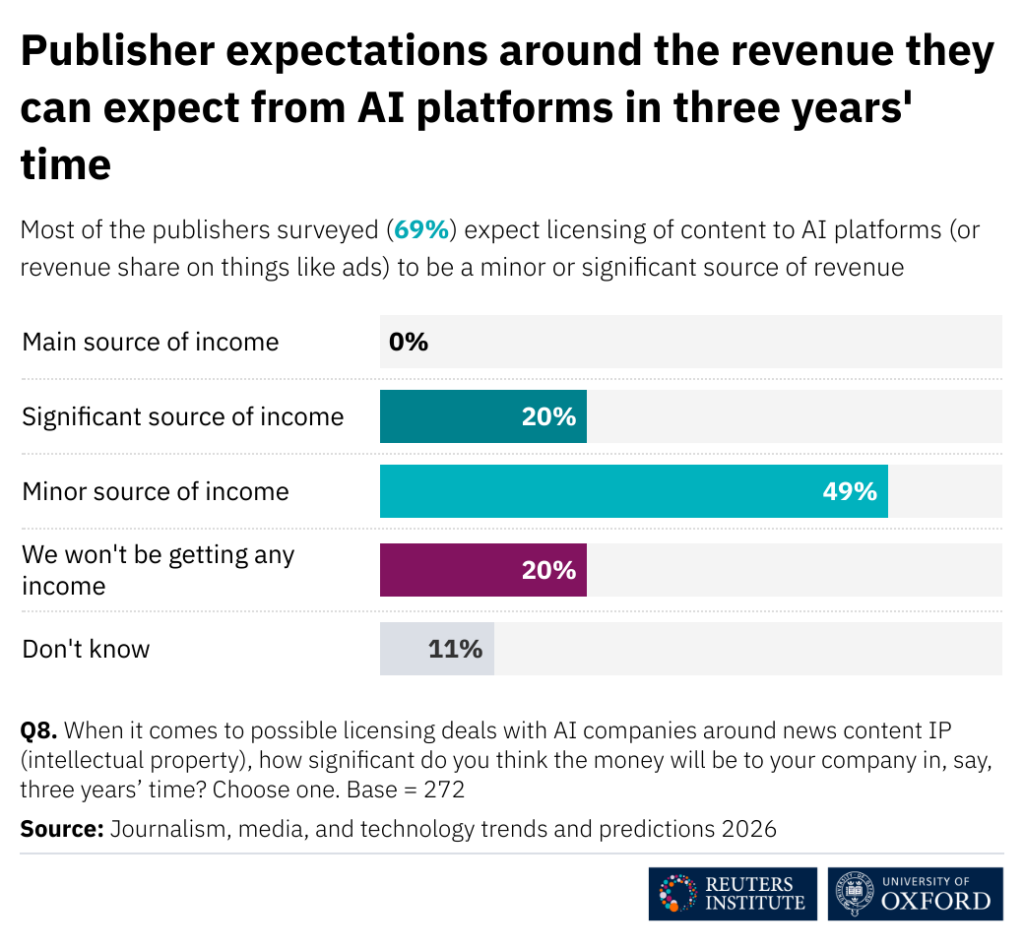
Global publishers largely expect AI deals to bring in some revenue, but not materially enough to change their business. The takeaway: licensing and revenue shares may help at the margins, but they won’t save news organizations from needing stronger reader revenue, products and brands of their own.
Source: Reuters Institute
primary sources
How industry leaders are thinking about AI, trust and what comes next

“We believe it’s vital for newsrooms to engage with these AI tools. They’re transforming how audiences consume and engage with information, and local newsrooms need to be at the forefront of that shift to ensure we remain able to deliver on our primary mission.”
-Sarabeth Berman, CEO of American Journalism Project
As AI shapes the operation and economics of local news, the American Journalism Project is working to strengthen the nonprofit news outlets now anchoring local communities across the country. AJP CEO Sarabeth Berman speaks with Aspen Digital about what sustainable local journalism looks like in an AI-driven landscape. The discussion has been edited for clarity and length.
Aspen Digital: AJP recently reached a milestone of 54 portfolio newsrooms employing more than 700 full-time staff. What does this scale tell us about whether nonprofit news has moved from experiment to proven business model and civic information infrastructure? And what’s still missing?
Sarabeth Berman: The breadth of our portfolio is meaningful, but what actually tells the story are the results we’re seeing. Our portfolio saw 23% year-over-year growth in median revenue in 2024. Organizations are reducing their reliance on any single funder, diversifying across foundation grants, major gifts, membership, and earned revenue. The first 25 organizations to complete our three-year investment cycle, which are focused on building business and revenue capabilities, have more than doubled their median budgets and continue to grow, many even after their grants have closed. Bigger budgets mean more local journalists and more local news and information.
Nonprofit news emerged in response to the market failure of the American newspaper industry and the clear evidence that the decline of local news is affecting the strength of our communities. It is no longer a proof of concept. It is a viable and growing model for building civic information infrastructure. The question is no longer whether it can work, but how quickly we can expand and replicate what is working. What we need now is a true cultural shift in how communities understand and value local news. What we’re really talking about is reframing local news as a public good: something a community funds and sustains together because it serves everyone.
Aspen Digital: You’ve described AJP as having a “fast learning metabolism” — launching, investing, learning, and evolving — as a local news venture philanthropy. With nearly five years of portfolio data now, what’s the most surprising lesson about what actually makes nonprofit newsrooms sustainable, and how does AI fit into that equation?
Sarabeth Berman: There is no silver bullet solution or playbook that can be applied everywhere. Sustainability starts with a clear vision for the community you serve. The organizations that are thriving are led by people who are explicit about the impact they want to have and disciplined about delivering on that vision. They are equally strong at making the case for their work to readers, philanthropists, and companies. What that looks like in practice is leaders who are rigorously focused on three things: genuine responsiveness to the information needs of their communities, editorial quality, and building a strong business. None alone is enough. Artificial intelligence fits into that equation if it helps newsrooms operate more effectively and efficiently, so the humans at the center of this work can focus on what only they can do, like build relationships, exercise judgment, and be accountable to their communities.
Aspen Digital: The AJP’s Product and AI Studio’s work has been supported by funding from OpenAI. As the OpenAI partnership continues, what are AJP’s goals for the next phase? Are there specific challenges or opportunities in nonprofit news that will be addressed?
Sarabeth Berman: We launched the Product & AI Studio with support from OpenAI and the Patrick J McGovern Foundation in 2023, months after the viral release of ChatGPT and generative AI had come into public consciousness. The goal for the first phase was to support newsrooms in their comfort and capabilities, experimenting with these tools in responsible ways. We seeded and supported many pilots, and we shared lessons along the way. Since then, local newsrooms have grown more confident and sophisticated in how they approach these tools. And advances in large language models and more accessible infrastructure have also lowered the barriers to building practical applications. The next phase of our work moves from experimentation alone to building and sharing the most promising use cases. Now, we’re working with portfolio organizations to turn the strongest ideas into durable tools that address core sustainability challenges.
Aspen Digital: AJP’s Product and AI Studio released its Field Guide: AI for Local Reporting in 2025. Beyond transcribing public meetings and handling commodity information such as data sifting, where do you see AI creating editorial and business value without substituting for human judgment?
Sarabeth Berman: Our portfolio organizations approach this with a “human in the lead” mindset rather than “human in the loop.” AI supports and augments their work, but human judgment and deep understanding of the audience always drives the decisions. Translation is one of the most compelling examples. Enlace Latino NC, a Spanish-language news organization, used AI-powered translation to produce their first English-language newsletter, building on prior work from Centro de Periodismo Investigativo — work that Boyle Heights Beat also leveraged during the L.A. fires earlier this year. The Enlace team created a custom translation tool combining the AP Stylebook, internal guidelines, and prompts tailored to their publishing style. The newsletter has already exceeded subscription goals, reaching second- and third-generation Latinos and opening the door for new sponsorship opportunities.
Aspen Digital: Some newsroom leaders believe AI tools will erode editorial quality or compromise newsroom values. How do you counsel newsroom leaders who are hesitant about AI adoption?
Sarabeth Berman: I can certainly understand why newsroom leaders feel this way, but we believe it’s vital to engage with these tools. They’re transforming how audiences consume and engage with information, and local newsrooms need to be at the forefront of that shift to ensure we remain able to deliver on our primary mission. We recommend two important first steps.
The first is to engage your team in developing guidelines for AI usage, and to do it now. Nearly three out of four journalists have already tried generative AI on the job, according to a 2024 AP study, and almost 70% have used it to help produce editorial work. Yet only about 20% of local news organizations have public AI usage policies. That gap is worth closing. We created a guide to help newsrooms get started. The second is simply to use these tools. Understand how they work, get comfortable with prompting, and try out different LLMs to understand their tradeoffs. Our team has released prompt packs and guides to common use cases to help newsrooms get started.
Aspen Digital: Looking ahead, what’s the most important question local news leaders should be asking about AI that most aren’t considering yet?
Sarabeth Berman: Most conversations about AI in newsrooms focus on internal workflow. The question we’d push leaders to consider is: how is AI changing the way your audience finds and consumes information? A 2025 Harvard Business Review study found that the top use cases for generative AI have shifted decisively toward the personal — people are turning to AI for mental health support, goal-setting, and day-to-day decision-making. That’s a fundamental change in how people relate to information and where they turn for guidance. Local newsrooms need to be thinking about what that means for their audiences and their role in their communities.
There’s also an operational question that doesn’t get enough attention: what does AI-generated software mean for how newsrooms build and use technology? Advances in this space are materially lowering the barriers to producing technology and analyzing data in ways that were previously out of reach for smaller organizations. That has real implications for the relationship between newsrooms and their software providers, and it opens new doors for finding stories and getting information to audiences in ways we’re only beginning to understand.
In the feed
One share worth a closer 👀
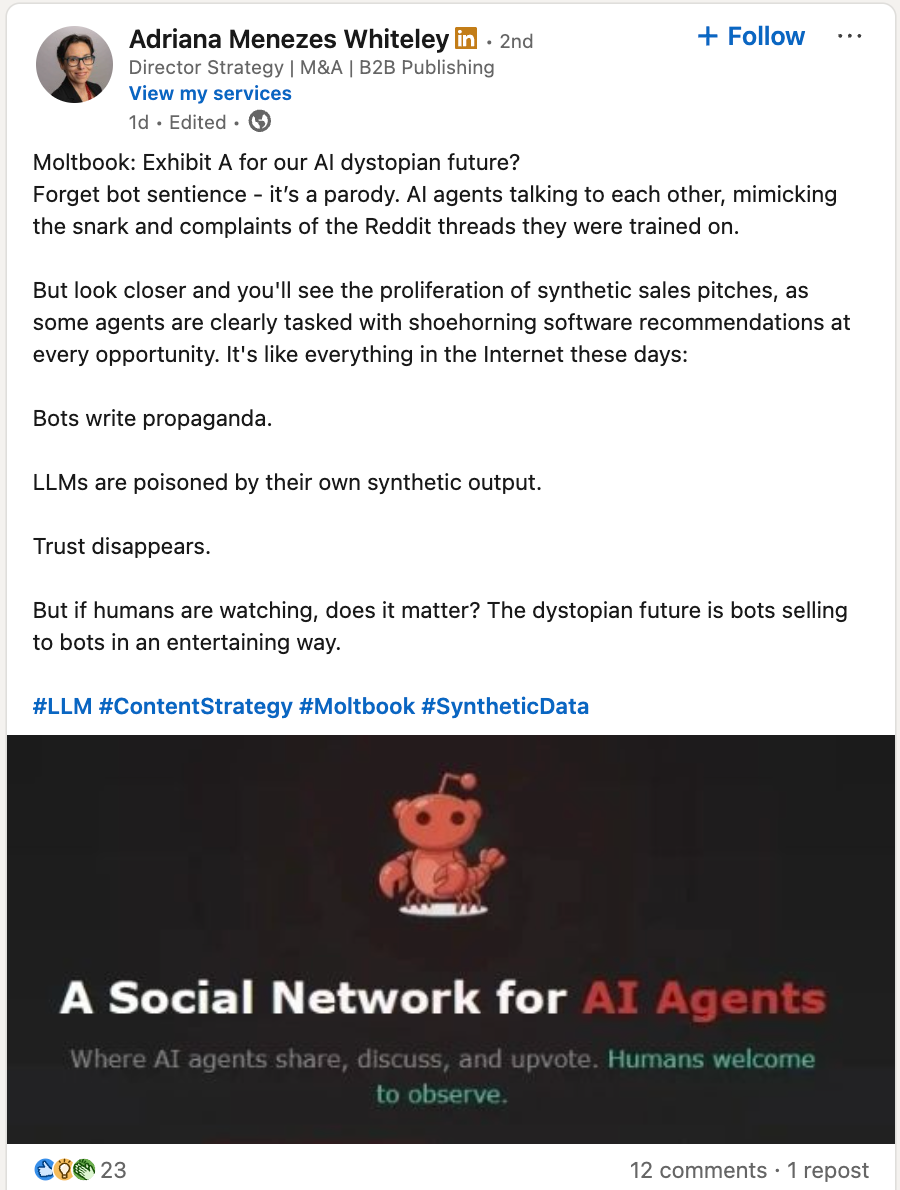
The buzzy launch of Moltbook, a social network for AI agents, teases what might be an emerging force: synthetic social networking. In a content ecosystem shaped by bots talking to bots, trusted news brands with original reporting and human-led judgement may matter even more to audiences.
Source: Adriana Menezes Whiteley, LinkedIn
stay in touch
Explore our full library of research and resources, and sign up for this newsletter (if not already).