
 Facebook
 Twitter
 LinkedIn
 Email
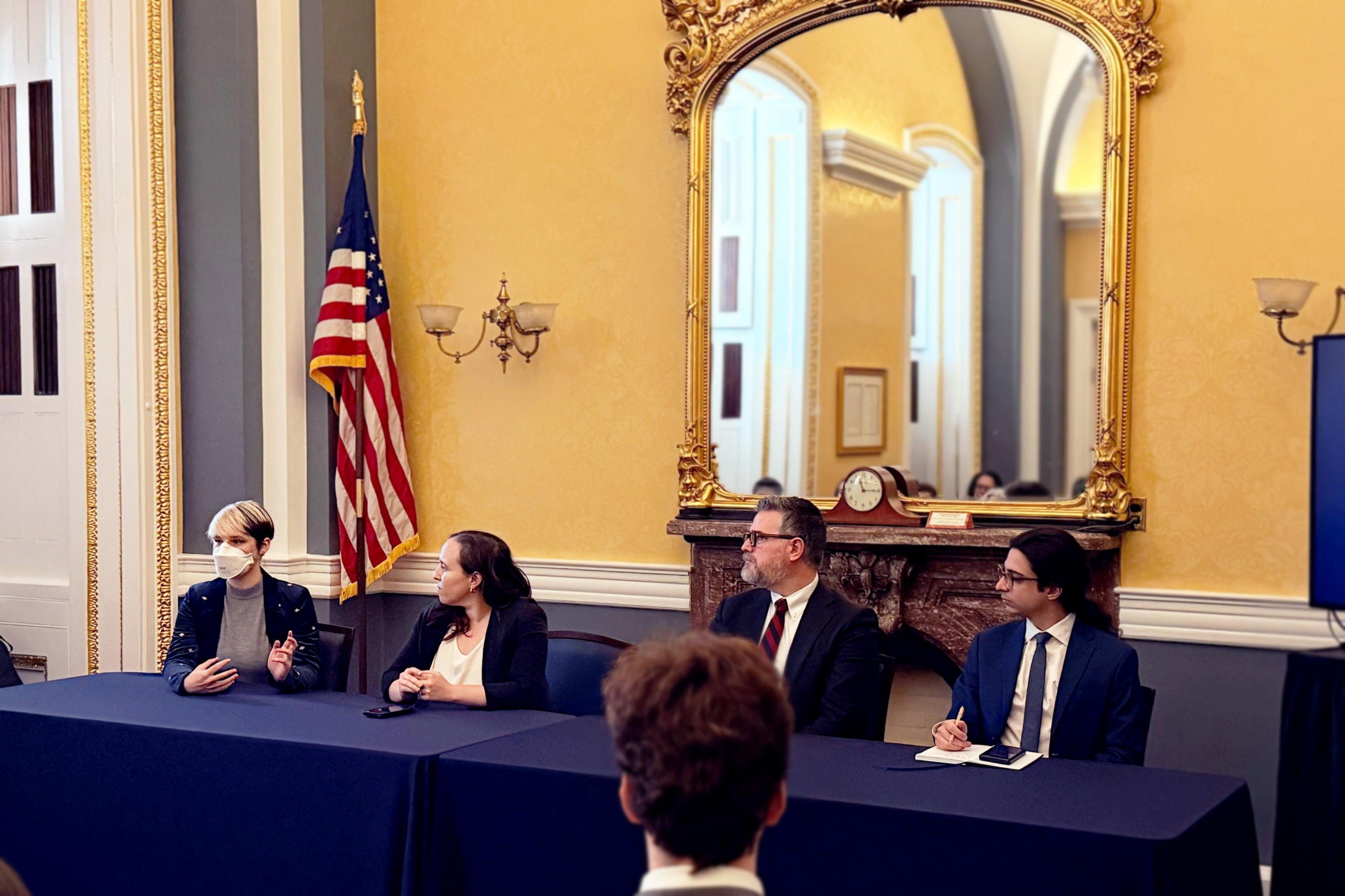
EmailIn March, Aspen Digital hosted a panel on the Hill on different strategies for defining AI in the policy context. Participants included representatives from 11 different Congressional offices and committees as well as participants from CRS and the Library of Congress. Panelists debated the strengths and weaknesses of different approaches spanning the John S. McCain National Defense Authorization Act, California Bill SB-53, and the Algorithmic Accountability Act.
This event accompanied the release of the print edition of Defining Technologies of Our Time, a handbook exploring the most influential definitions of AI in the US policy context with legal and technological rationales for why a policymaker should choose one potential definition over another in context.
Panelists

Miranda Bogen
Author of analysis of California Bill SB-53
Read about Miranda
Miranda Bogen is the founding Director of CDT’s AI Governance Lab, where she works to develop and promote adoption of robust, technically-informed solutions for the effective regulation and governance of AI systems.
An AI policy expert and responsible AI practitioner, Miranda has led advocacy and applied work around AI accountability across both industry and civil society. She most recently guided strategy and implementation of responsible AI practices at Meta, including driving large-scale efforts to measure and mitigate bias in AI-powered products and building out company-wide governance practices. Miranda previously worked as senior policy analyst at Upturn, where she conducted foundational research at the intersection of machine learning and civil rights, and served as co-chair of the Fairness, Transparency, and Accountability Working Group at the Partnership on AI.
Miranda has co-authored widely cited research, including empirically demonstrating the potential for discrimination in personalized advertising systems and illuminating the role artificial intelligence plays in the hiring process, and has helped to develop technical contributions including AI benchmarks to measure bias and robustness, privacy-preserving methods to measure racial disparities in AI systems, and reinforcement-learning driven interventions to advance equitable outcomes in products that mediate access to economic opportunity. Miranda’s writing, analysis, and work has been featured in media including the Harvard Business Review, NPR, The Atlantic, Wired, Last Week Tonight, and more.
Miranda holds a master’s degree from The Fletcher School at Tufts University with a focus on international technology policy, and graduated summa cum laude and Phi Beta Kappa from UCLA with degrees in Political Science and Middle Eastern & North African Studies.

B Cavello
Director of Emerging Technologies at Aspen Digital
Author of analysis of the Algorithmic Accountability Act of 2022
Read about B
B Cavello is a technology and facilitation expert who is passionate about creating social change by empowering everyone to participate in technological and social governance. They serve as director of emerging technologies for Aspen Digital, a program of the Aspen Institute. B also serves as assistant program chair for the Neural Information Processing Systems (NeurIPS) Conference, as a 2025 research fellow with Siegel Family Endowment, and as a board member to Metagov, an interdisciplinary research nonprofit promoting digital self-governance.
Previously, B advised Senator Ron Wyden on issues of privacy, internet governance, and algorithmic accountability. Prior to Congress, they were a research program lead at the Partnership on AI, senior engagement lead for IBM Watson, and director of both product development and community at Exploding Kittens. B has been recognized as an LGBT+ ‘Out Role Model,’ Global Crowdfunding ‘All-Star,’ and was selected as an MIT-Harvard Assembly Fellow for the 2019 Ethics and Governance in Artificial Intelligence Initiative cohort.
Mark Dalton
Author of analysis of the John S. McCain National Defense Authorization Act
Read about Mark
Mark Dalton leads R Street’s technology and cybersecurity policy portfolios as the organization’s senior director of technology and innovation.
Before joining R Street, Mark served as head of strategic planning at the U.S. Naval Undersea Warfare Center (NUWC) Division Newport, where he played a key role in aligning the organization’s acquisition and research initiatives with the strategic needs of the Navy and the Department of Defense. Prior to that, he served as NUWC’s chief engineer for undersea warfare cybersecurity, delivering technical excellence in cyber solutions across research, development, engineering, and testing. He also established NUWC’s inaugural portfolio of cybersecurity research and development, strategically focusing on leveraging artificial intelligence, machine learning, and formal mathematical methods to combat cyber threats.
As a computer scientist, Mark conducted research in the application of reinforcement learning to optimize behaviors in autonomous systems. He also managed numerous installations and tests of prototype technologies aboard U.S. Navy submarines worldwide.
Mark holds a master’s degree in national security and strategic studies from the U.S. Naval War College, a master’s degree in computer science from the New Jersey Institute of Technology, and a bachelor’s degree in information technology from the University of Massachusetts Lowell. He is currently pursuing a PhD in international relations at Salve Regina University.
Mark resides in Portsmouth, Rhode Island, with his wife, Nichole, and their 18-year-old daughter, Addison. His 3-year-old dog, Ziggy, is his loyal officemate.
Moderator
Nicholas P. Garcia
Senior Policy Counsel at Public Knowledge
Read about Nicholas
Nicholas P. Garcia is a Senior Policy Counsel at Public Knowledge, focusing on emerging technologies, intellectual property, and closing the digital divide. Before joining Public Knowledge, Nick served as an Assistant District Attorney in the Investigations Division of the Bronx County District Attorney’s Office, where he investigated and prosecuted cybercrime, fraud, grand larceny, and organized crime. He previously worked as a Legal Intern at Public Knowledge and as a Student Attorney for the Communications & Technology Law Clinic at Georgetown University Law Center’s Institute for Public Representation.
Nick received his J.D. from Georgetown University Law Center, his M.A. in Ethics and Society from Fordham University’s Center for Ethics Education, and his B.A. in cursu honorum in Philosophy from Fordham University, where he was a member of the Phi Sigma Tau Honor Society.
Nick is a native New Yorker, and an unabashed nerd who loves video games, science fiction, and tabletop RPGs.
This event was made possible thanks to our sponsor, Senator Wyden’s office and support from Fathom.