

 Facebook
 Twitter
 LinkedIn
 Email
EmailThis spotlight presents the top strategies for improving production and resource management, including addressing challenges related to low yields, limited access to inputs, and poor management of natural resources.
These findings represent survey input from 98 participants working in food security across 20 of the 22 UN Statistical Division geographical regions. In the Regional Breakdown of Results section, responses are grouped into three clusters by Human Development Index (HDI) based on the geographies of participants’ work: Less Developed Regions, More Developed Regions, or Most Developed Regions. For more information on our methodology and the full list of challenges and strategies, see the Feeding the Future main report.
Production and Resource Management are foundational components of food security. Thanks to technological progress and institutional developments over the past decades, it has been possible to increase food output to previously unthinkable levels. However, major questions remain—especially related to environmental sustainability, equitable access to essential inputs such as water and fertilizers, and the nutritional quality of the food being produced. The preferred strategies for this challenge reveal a clear goal: increase equity across the system.
Overall Top Strategies for Production & Resource Management
#1 Establish decentralized hubs for distributing agricultural inputs (e.g., seeds, fertilizer) in underserved areas
While there are a variety of mechanisms for addressing challenges in Production and Resource Management, the top selected strategy focuses on geographic equity in the distribution of production inputs. Participants prioritized increasing underserved actors’ access to key inputs and tools, such as fertilizers, whether by lowering their prices or facilitating their distribution. The most highly ranked strategies do not necessarily aim to increase the overall quantity of food produced, but rather to ensure that production better includes and supports smaller or more vulnerable actors within the system. This pattern also promotes food production by a greater number and variety of actors, creating the potential for more resilient decentralized food systems.
#2 Increase tools available to smallholder farmers for forecasts, risk planning, and response
Participants’ second preferred strategy also focuses on small-scale actors but emphasizes prevention and resilience. In general, food production led by smallholder farmers is more exposed to risks related to climate events, institutional instability, outdated infrastructure, and land insecurity, among others. There are a growing number of tools for monitoring data and anticipating impacts, but many remain out of reach or ill-suited for smallholder contexts due to connectivity gaps, language barriers, and cost. This strategy aims to build bridges that connect farmers with more tools and systems designed to enhance their ability to forecast and effectively adapt to risks.
#3 Increase tools available to smallholder farmers to leverage personalized data for daily farm operations
While data is already widely in use by many large-scale industrialized food producers, effective tools remain out of reach for many smaller producers. Echoing the second strategy’s emphasis on forecasting and the first strategy’s emphasis on decentralization, this strategy suggests that survey participants are optimistic about data use for increasing the efficiency and effectiveness of smaller producers. There is room for innovation both in how data is collected and produced (e.g., low-cost sensors, earth observation imagery, inputs from farmers) and also in how tools for smallholder farmers are designed (e.g. voice interfaces, offline and low-power tools).
#4 Make drip irrigation and other water-saving technologies more affordable and accessible
Participants underscored that improving access to efficient irrigation is not only a matter of productivity but also of resilience and equity, since small-scale producers are often the most affected by water scarcity and the least able to invest in meaningful interventions. Their responses reflect a shared understanding that improving food security increasingly depends on the efficient management of limited natural resources like water, and that affordability remains the key barrier preventing wider adoption.
#5 Improve prediction of demand for food to better target food supply and distribution and reduce food waste
Mismatches between supply and demand are a major driver of food loss, and better forecasting and information systems can significantly improve distribution efficiency. Improving the prediction of food demand can turn guesswork into coordination across the food system. When demand signals reliably guide procurement, storage, and distribution, governments and suppliers can align on resource management decisions rather than hedge through excess. Scaled across food systems, this approach lowers waste and improves access without necessarily expanding supply.
Regional Breakdown of Results
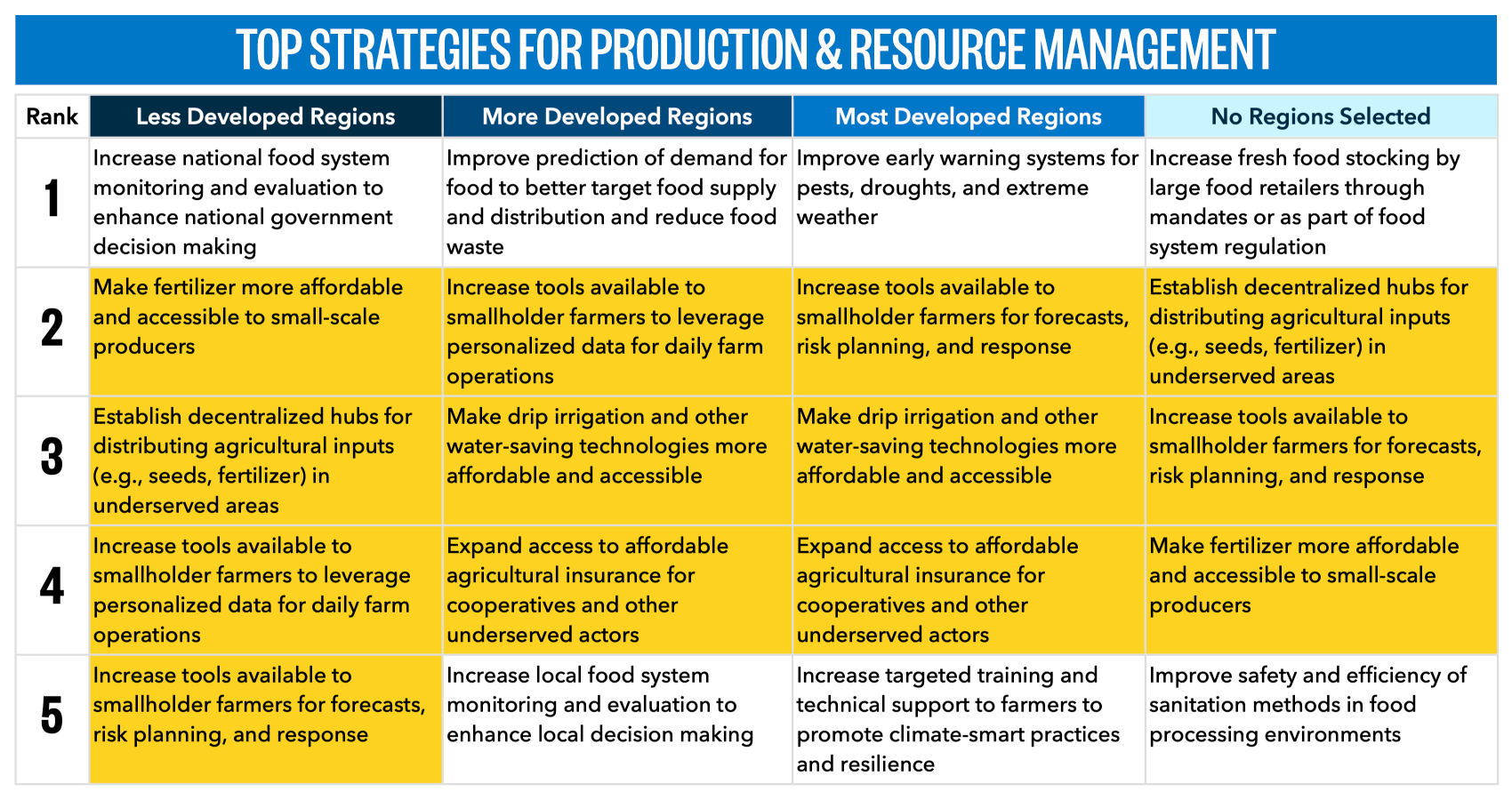
Most of the strategies ranked in the top five were similar across professionals working in regions with different levels of development, suggesting a strong set of cross-cutting priorities. However, an interesting pattern emerges: the top strategy in each development region cluster was unique. This highlights that, while breakthroughs in shared strategies are likely to yield shared progress, there is still specific work to be done to address the specific needs of communities across development levels.
Feeding the Future Challenge Spotlight: Production & Resource Management © 2026 by Aspen Digital is licensed under CC BY 4.0.