
 Facebook
 Twitter
 LinkedIn
 Email
In this issue
- Premium News or Cheap Information?: AI may split the news market into luxury and commodity tiers, leaving local outlets in the “hollowed out” middle.
- The Next Journalism: Tom Rosenstiel, author of a new book on journalism’s future, tells Aspen Digital what AI means for newsroom work and how the industry needs to redefine its value.
- What Readers Want from AI in News: A new interactive lets you explore how nearly 7,000 people in six countries view AI’s role in journalism.
Sign-up to receive future issues in your inbox 👉
Subscribe below
The big picture
The strategic question every publisher is wrestling with right now
Premium News or Cheap Information: Where Does Local News Fit in the AI Era?
As AI changes how people get their news, a new, more divided media landscape may be taking shape: premium journalism for audiences who can afford to pay, and low-cost information distributed to millions. Local journalism risks getting squeezed in between.
At the Nordic AI in Media Summit in Copenhagen this spring, Shuwei Fang, a Shorenstein Fellow at Harvard Kennedy School, said the market for news “could start to bifurcate between luxury and commodity,” leaving a “hollowed-out middle.” In Fang’s formulation, premium publishers attract paying members through trusted reporting, a strong identity and events that bring audiences together. At the other end, news information is supplied to platforms and AI systems. The middle, “where most news organizations sit today,” faces an uncertain future, Fang contends.
Why This Matters Now
For local news, the stakes are all too familiar: the regional daily, the nonprofit newsroom, the statehouse bureau or the investigative team spend months producing one story. Yet, many struggle to attract enough paying readers to cover the cost of sustained, in-depth reporting. New findings show how much ground local news is losing. Northwestern Medill’s 2026 State of Local News report counts 238 local news desert counties, up 26 in a single year. Newspapers are closing at a rate of about three a week, and 47-million Americans have limited or no access to local news. The report tallied 75 new local startups over the same period, but that is “not coming close to what is being lost,” says Medill’s Tim Franklin.
AI is entering a market already struggling to support local reporting. The question for news leaders – and funders and policymakers – is who will provide reliable coverage as more outlets disappear.
What’s Actually Happening
Publishers are losing readers at the same time as AI platforms are offering another way of getting information without visiting a site, or signing up for a newsletter. Medill’s researchers found that traffic to the largest 100 local newspapers has fallen almost 50% since 2022. Publishers with loyal subscribers have some protection. Those that depend on search engines or social platforms to reach readers are far more vulnerable.
Some news providers have found new revenue in selling data and analysis. But the opportunities depend on what a news organization offers—and who is willing to pay for it. In Who Will Monetize Truth?, news technologist Francesco Marconi argues that the industry is splitting into three kinds of news businesses: intelligence suppliers like Bloomberg, attention aggregators like CNN, and public-good journalism providers like PBS. His assessment of local accountability reporting is stark: it “will never generate sufficient market returns” and needs to be supported “the way we fund libraries.”
Tom Rosenstiel, journalism educator and author of the new book The Next Journalism: How the Press Must Change to Serve Democracy sees room for local newsrooms to adapt and serve audiences seeking both in-depth and daily news. “The viable news organization of the future lives in both spaces,” he tells Aspen Digital. He points to the Boston Globe where a dedicated desk handles fast-moving news, freeing other reporters to explain what happens and why it matters.(See more of our Q&A with Rosenstiel in this month’s Primary Sources feature.)
What to Watch Next
- Can smaller newsrooms adopt the Globe’s approach? Giving some staff responsibility for breaking news could protect time for explanation and investigations, but small teams may struggle to divide the work. Could AI help with routine work and free up time for deeper reporting?
- Will AI licensing bring meaningful revenue to local publishers? Watch for collective deals that give smaller outlets a stronger negotiating position.
- Can state support help keep local journalism alive? California Gov. Gavin Newsom signed a law in late September offering tax credits to help local newsrooms hire and retain journalists. The push extends well beyond California: more than 15 states are pursuing new proposals to support local news this year, according to Rebuild Local News.
- Can new outlets replace what’s disappearing? The number of startups matters, but so does whether they are emerging in the communities actually losing coverage.
🔍 Go Deeper: Medill’s State of Local News Report 2026 includes county-level maps and data and Francesco Marconi’s Who Will Monetize Truth? examines the business case for selling intelligence and the funding challenge for public-service journalism.
signal scan
A curated round-up of how AI is reshaping news – and trust
Meta to Delay New Commercial Terms Criticised by Publishers, Advertisers
Just days before it was to take effect, Meta has delayed plans to scrape and reuse content from any site tied to a Facebook or Instagram business account. The proposed move has alarmed news publishers, regulators and advertisers.
Source: Reuters
In the AI Age, Publishers Who Understand What Readers Want Will Do Best, New Report Argues
A new Tow-Knight Center report argues even scoops can lose economic value quickly when AI repackages them. Publishers now face harder choices about what to cover – and what makes their work indispensable.
Source: Nieman Lab
Guardian and Sun Agree on Ban for Deceptive AI Bots
Eight of the UK’s largest news publishers, joined by Conde Nast and Reddit, want a law forcing AI crawlers to disclose who runs them and what they’re scraping.
Source: Press Gazette
Inside the Rise of AI-native Newsrooms Run by Autonomous Agents
What does it take and what does it mean to run a newsroom operated largely by AI agents? The Reuters Institute asked founders of five AI-forward news outlets where automation works best so far, and where humans are still needed.
Source: Reuters Institute
Life after SEO: How Newsrooms are Adapting to the AI Search Shift
With Google search referrals to publishers plunging 40% in a year, according to Chartbeat, newsroom search leads explain why they’re now betting on brand and loyal readers over clicks.
Source: Reuters Institute
➕ Quick Hits: Current Affairs magazine promises to just say no to AI and stay “handmade” (link) … One reporter, 52 stories, 1 day: Inside Quartz’s AI content machine (link) … How two 23-year-olds created the top news app in Argentina with AI audio (link) … ChatGPT can draw a New Yorker cartoon – and sign the real cartoonist’s name (link) … An AI safety nonprofit is putting $10 million into newsrooms covering AI (link) … Google is paying 400+ publishers to let its AI summarize their reporting – but is tight-lipped about the terms (link)
DEEP DIVE
➡️ Read: The News and AI Field Report: What News Organizations Built with AI, 2022–2025
(Source: Knight Center for the Future of News at Arizona State University)
➡️ Watch: What Publishers Want From AI Companies
(Source: The Rebooting)
➡️ Listen: Kevin Roose on the Singularity and His Council of Claudes
(Source:Semafor)
Data point
An AI and News trend visualized
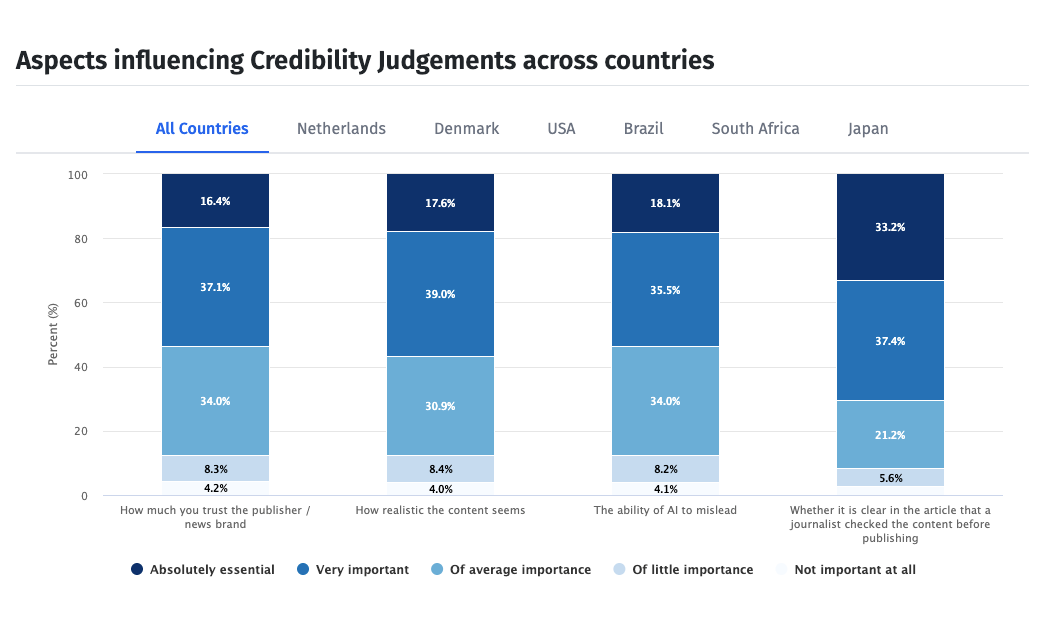
Explore the Global AI in Journalism Aspects influencing Credibility Judgements – AI & Journalism Explorer Monitor for how people in six countries judge AI’s role in journalism, from what still counts as “authentic” news to which rules should govern it. The AI, Media and Democracy Lab surveyed nearly 7,000 people in Brazil, Denmark, Japan, the Netherlands, South Africa and the U.S., and the dashboard lets you compare results by country, age, gender and education.
Primary Sources
How industry leaders are thinking about AI, trust and what comes next

“A generation ago the news industry largely hesitated when the internet arrived and began to disrupt the news business. That was a predictable but profoundly misguided reaction. If we make that same mistake now, the worst use cases of AI will fill that void.”
-Tom Rosenstiel,
Author of The Next Journalism: How the Press Must Change to Serve Democracy
As AI draws search traffic from news sites, and hands budget-conscious executives a new rationale for cost cuts, Tom Rosenstiel argues that journalism must quickly transition from an era of attention seeking to becoming more useful in people’s daily lives. The author of the newly published The Next Journalism speaks with Aspen Digital about the difference between AI that improves reporting and AI that simply makes it cheaper and where newsroom leaders should start. This discussion has been edited for clarity and length.
Aspen Digital: In your new book you make the case AI is the newest technology publishers are hoping will help them reverse decline. What’s the risk that newsrooms treat it as another quick fix instead of confronting deeper problems?
Tom Rosenstiel: We used to practice a journalism of attention because in the old economic model of news we got the audience’s attention and then rented that attention to advertisers. Newspapers derived 80% of their revenue from ads, TV (prior to cable) 100%. And – the data is very clear – about how we got people’s attention. We did stories about things that were wrong (the watchdog barking) and things that were weird (man bites dog). Study after study shows those are the two dominant news values. They even dominate how we do coverage of politics and government.
Meanwhile, as journalists we didn’t have to think all that much about how to make our stories useful or even what information would help people live their lives. If anything, we tended to look down at “service” journalism. And as newsrooms shrank, we did less of it. That won’t work anymore. In a world in which most of the revenue must come from consumers, or members, or donors, the news itself must become indispensible. That means we need to think about what job each story is doing to help readers live their lives and improve their communities. If anyone thinks AI is a quick fix to that conceptual shift, they will only accelerate journalism’s decline.
Aspen Digital: You describe the long-promised shift from journalism as a product to journalism as a service as finally underway, built around giving people solutions and what they actually need. How does AI help publishers make that shift?
Tom Rosenstiel: AI can be part of making that shift, but only as a tool, not as a singular solution. The shift needs to be a cultural and conceptual one in newsrooms, not merely a technological one. If publishers need a shorthand simple rule about what AI is going to help versus what AI is not, I would offer this: AI tools that are designed to help journalists make their reporting more comprehensive and accurate – that improve the quality of the news product for the consumer – are good. AI tools that are designed to remove people from the reporting and writing process primarily to make it cheaper, will only weaken an already inadequate product.
What is an example of a tool that makes the reporting better? At the University of Maryland we have built tools that can monitor government meeting transcripts and live streams looking for stories or issues or decisions that journalists want to track. Suddenly, we can have 100 civic meetings monitored in the state every week that were going unmonitored and alert a reporter to anything the reporters or editors had deemed relevant beforehand. Other tools can scan interviews reporters have done against fact checkers and other digital resources to see if those interviewed made statements that were demonstrably false.
What’s an example of a bad AI tool? Write my story for me. Do my interviews for me. Build a newsroom for this town that has no reporters or editors but pumps out machine produced stories with bylines of people who are not real and pretend you have built a news organization.
Aspen Digital: You’ve pointed out that when AI answers questions directly, a newsroom’s archive can become more valuable, not less. How should publishers be thinking about their back catalog now – as just a library that can be accessed more easily with AI or something more?
Tom Rosenstiel: There are a few things. One, which we are seeing already, is for newsrooms to build a bespoke AI archive of their work and then build chatbots in which members of the public can query the newsroom about the news and answer their own questions. It needs to be done well. The builders of those tools need to build them in such a way that they have tried scores of prompts, asked the chat bot every question they can think of, in effect road testing the bot. And cleaning up hallucinations. It’s not as simple as it might seem. It only takes one false answer for someone to dismiss that product as a disaster and to tell their friends and family not to trust it. Another example of how to use archives is internal. We in journalism test the accuracy of our work story by story. Did we spell the names right? Did the story seem fair? Done. But we do not go back very often over a year or two to assess how we have covered this topic or this community? Have we done so fairly, comprehensively? Have we represented the reality of that topic well? Have we covered that community holistically and depicted it accurately? At Maryland, again, we are building a tool that newsrooms can use to do just that.
Aspen Digital: Recently, McClatchy laid off more than 90 journalists while pushing an AI tool that repurposes reporters’ existing work into new stories. Your book is hopeful about AI, but on the ground it’s often the justification for cuts. How do you square the promise you write about with what’s clearly happening to jobs?
Tom Rosenstiel: Nowhere am I hopeful that AI will be a justification for job cuts. I advocate that we rush to build AI tools that can improve the journalism, not make it cheaper. The reason we need to move quickly to build AI tools to strengthen our newsgathering is so we can fend off those who are building tools, and trying to sell them to the news industry, purely to replace people. If we wait, or hesitate, that is exactly what will happen.
A generation ago the news industry largely hesitated when the internet arrived and began to disrupt the news business. That was a predictable but profoundly misguided reaction. If we make that same mistake now, the worst use cases of AI will fill that void. We need to fill the void with AI that helps. Or it will be filled with AI that may create a civic holocaust in a lot of communities.
Aspen Digital: At Aspen Digital’s recent “Publishers, Platforms and the Future of News” convening, one worry kept surfacing: AI is becoming a personalized layer between audiences and the newsrooms that pay for reporting, answering the question so readers never reach the source. If that becomes most people’s front door to news, what happens to the outlets doing the original work?
Tom Rosenstiel: The only way I think that AI becomes a main entrance to a news organization would, again, be a chatbot of a newsroom’s archive. And it better be as close to accurate and bulletproof as you can make it. Do it badly and you hurt yourself. But that is not the only entrance to the news product. A successful news organization has to be a house with many doors. It might be high school sports. Or databases about education. Or topic pages that can catch me up on the news (imagine a wWikipedia page that is updated whenever a new event happens). Or it could be Q&As on key topics. It could be recipes. For many daily New York Times readers the front door is the games.
Yes, AI is harming traffic. The solution is to build news products that go beyond the classic news story about what happened yesterday – the basic alert or update story – and start producing content that helps people live their lives. Some of that content will be conventional news stories. More of it than in the past will be content that is not so ephemeral, that is more evergreen, and that is rich enough that a crappy Chat GPT or Gemini summary is no substitute for the thing itself. Journalism no longer needs to be simply what happened yesterday. That is an artifact of another technology.
Aspen Digital: For the news leader who’s convinced and wants to act on AI, what’s the first thing they should do?
Tom Rosenstiel: The book is about how journalism needs to change conceptually and walks through 10 different important ways to do that. There is one chapter in which I talk about AI, and that mostly addresses how newsrooms should take public data from their communities and try to build what I call a “civic internet” of data that people can navigate on their own.
in the feed
One share worth a closer 👀

Media analyst Doug Shapiro argues that AI will weaken the link between time spent with content and the value people get from it because anyone can now compress a long piece to suit their purpose. To prove it, he had Google’s AI tools turn his own essay into a 13-page visual summary.
EVENTS ON THE HORIZON
Where the AI & News Conversation Will Take Center Stage
- London Trust Conference – November 4-5
- JournalismAI Festival in London and Online – November 17-18
- WAN-IFRA Newsroom Summit 2026 in Oslo, Norway – November 18-19
- National Journalism + AI Accelerator at Arizona State University in Phoenix, AZ – January 5-7
- Medill Media Summit in Chicago – March 11-12, 2027
- Investigative Reporters & Editors NICAR 2027 in Denver, CO – March 11-14, 2027