

 Facebook
 Twitter
 LinkedIn
 Email
EmailIn this issue
- Who Will Do the Work?: Journalism’s talent pipeline was already contracting. AI is accelerating the squeeze.
- Rebuilding News in Tech’s Backyard: Kevin Delaney of The San Francisco Standard tells Aspen Digital why reporting still matters in the age of AI – but so does product innovation.
- The “Largest Theft in Human History”: Newly unsealed findings reveal how AI companies talked about training on news behind closed doors.
Sign-up to receive future issues in your inbox 👉
Subscribe below
The big picture
The strategic question every publisher is wrestling with right now
Who Will Do the Work Amid Rising AI Exposure?
September brought the starkest illustration yet of the peril facing American newsrooms. McClatchy – the chain behind the Miami Herald, The Kansas City Star and The Sacramento Bee – laid off more than 90 journalists across at least 13 papers, cutting the newsroom staff by more than 50% at the Lexington Herald-Leader. The company attributed the cuts to a steep drop in consumer revenue over the past five years.
The layoffs landed months after McClatchy’s staff revolted against a generative AI editorial tool that reworks reporters’ articles into new ones, a move that prompted more than 30 Sacramento Bee journalists to threaten to withhold their bylines. McClatchy says it isn’t swapping reporters for AI, but the layoffs come as newsroom leaders confront two shocks at once: AI is reshaping which jobs will continue to exist even as the schools meant to train journalism talent face steep enrollment declines.
Why This Matters Now
The job market journalism graduates are entering was hollowed out long before ChatGPT. Newsroom staffing fell 26% between 2008 and 2020, according to Pew Research analysis of Bureau of Labor Statistics data. Nearly all of that was in the newspaper sector where employment fell from 71,000 to 31,000 roles.
AI is the new factor layered on top of years of shrinking audiences and collapsing ad revenue. Ken Auletta, who has chronicled media and technology for decades as an author and longtime New Yorker writer, put the scale of the shift to Aspen Digital this way: “When your mind drifts back to how TV news made radio news more vivid, or 24-hour cable news challenged the fixed time slot of broadcast news, or instant digital news challenged next day news, and then think of AI’s potential impact on each, it’s hard not to conclude it will be bigger and more perilous.”
The emerging threat is clear: the functions most exposed to AI automation – aggregation, summarization, transcriptions and first-draft production – are disproportionately the tasks assigned to junior journalists. Strip them out and the on-ramp narrows precisely as the pipeline feeding the industry constricts.
What’s Actually Happening
Students see the writing on the wall. Journalism degrees in the U.S. fell nearly 13% from 2012 to 2019 according to analysis of federal data. A 2022 Georgetown Center on Education and the Workforce analysis found only about 15% of journalism and communications majors work in the field early in their careers.
That contraction is now being compounded by a threat that’s becoming all too familiar: AI job vulnerability. Field Report, which scores college majors on labor-market AI and automation exposure, puts journalism in troubling terrain across the board: entry salaries around $48K, a market shedding openings, roughly 7.2 graduates competing for every opening, growth essentially flat at 0.4%, and an AI-exposure score of 7.5 out of 10.
For their part, the schools are not standing still. Columbia’s journalism school has launched The Initiative on AI, training students and midcareer journalists to use AI responsibly, building reporting tools and studying AI’s effect on audience trust. And in September, OpenAI began supplying ChatGPT subscriptions to graduate students at CUNY’s Newmark J-School and Northwestern’s Medill.
The question these programs are addressing is not whether journalism students will use AI, but how the job itself – reporter, editor, tool-builder, fact checker – is being redefined while they teach it.
The Stakes for Newsrooms
- The talent bench: If entry level jobs erode and enrollment keeps falling, newsrooms may face a shortage of midcareer talent a decade out. The reporters who never got a job can’t become the editors of 2035.
- The skills mismatch: Newsrooms adopting AI need journalists fluent in it. Whether that fluency is developed in J-schools, on the job, or not at all will shape who staffs the newsroom of the next decade.
- The trust dividend: As automation handles more production, the distinctly human work – verification, judgment, accountability and on the ground reporting – becomes the differentiator. That raises the value of training and teaching, even as the market shrinks.
What to Watch Next
- Whether the role of the journalist formally broadens to include tool-builders, AI editors, and AI verification specialists – and whether newsroom titles and pay follow.
- Whether J-school enrollment stabilizes as AI-focused curricula draw a new kind of student – or if the pipeline continues contracting.
- Whether newsrooms rebuild entry level pathways around AI-fluency or simply eliminate the rungs.

A Note from Aspen Digital’s New Acting
Executive Director Konstanze Frischen
It’s such a privilege to introduce myself as the acting Executive Director of Aspen Digital. Having served as Managing Director and then Deputy Executive Director alongside the indomitable Vivian Schiller, I know firsthand the power of this community and I couldn’t be more excited to lead this team into our next chapter. I am particularly excited to carry forward our work on AI & News. Having been a journalist myself (at CNN, Die Zeit, and FAZ) I know firsthand the important role journalism plays in preserving the core tenets of trust and democracy we hold so dear in our societies. Each month, we will continue to bring you the most pressing matters fronting the news ecosystem in this newsletter, and we urge you to share this resource with your friends, colleagues, family, and more!
signal scan
A curated round-up of how AI is reshaping news – and trust
Microsoft Exec Called AI Scraping ‘the largest theft of labor in human history,’ New Unredacted Filings Reveal
Newly unsealed filings in The New York Times’ copyright case against OpenAI and Microsoft quote a Microsoft internal memo branding its own training practices “theft.”
Source: TechCrunch
Survey Finds Consumers Are Wary of Most AI Use in Local News
A Medill survey of Chicago-area adults finds that half think AI spellchecking is fine, but far fewer want it deciding coverage or writing stories.
Source: Nieman Lab
One in Five Britons Now Using AI to Access News
More than 20% now use AI apps for news – and that rises to 37% among 25-to-34 year olds. The catch: they trust AI and other intermediaries far less than traditional news sources.
Source: Press Gazette
Podcast: The Mushy Middle of AI Adoption
The former AI lead at Sweden’s Aftonbladet warns of a “mushy middle” of AI adoption, where news publishers bolt on tools while the product barely changes. The choice, he argues, is to become an AI-powered information service, or to build around human relationships.
Source: The Rebooting
Google Rolls Out Pay-Per_Value AI Licensing Program to Publishers
The search giant is quietly paying publishers when it decides their content has significantly “shaped” an AI overview answer. Publishers say the checks are real, but the math is a black box.
Source: DigiDay
➕ Quick Hits: Wired launches a new personalized app – without an AI chatbot (link) … Ohio’s largest newspaper is accused of putting a reporter’s byline on an AI-written article while she was honeymooning (link) … Hearst is using AI to cover public meetings its reporters can’t sit through (link) … Newsguard is keeping a running tally of midterm elections misinformation (link) Ask a chatbot about the elections and it may tell you what you want to hear (link).
Announcing the Winners of Online Journalism Award for AI Reporting
Aspen Digital, in partnership with Online News Association (ONA), is excited to share the 2026 winners for the Online Journalism Awards Topical Reporting: Artificial Intelligence category. These awards recognize journalistic works that clearly and accurately describe AI technologies from around the world.
Data point
An AI and News trend visualized
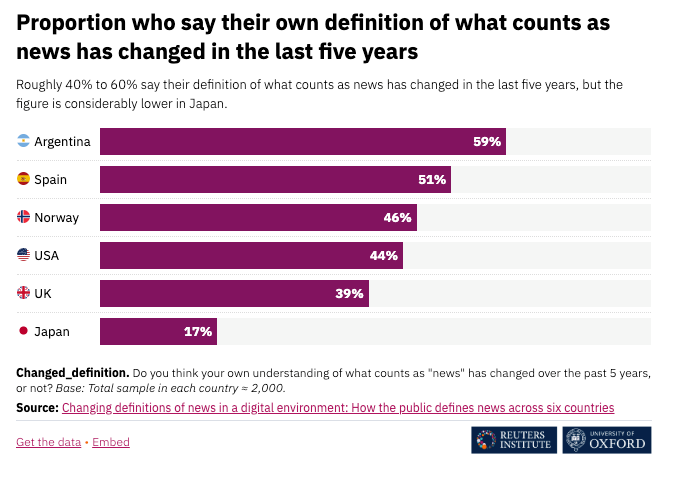
What counts as “news” is changing across the globe. In most of the six countries Reuters Institute surveyed, 40% to 60% of people say their own definition has broadened in just the past five years. In light of this, a question for publishers is whether AI’s chatbot summaries will fit people’s widening sense of news better than their traditional reporting.
Primary Sources
How industry leaders are thinking about AI, trust and what comes next

“I’d rather see journalists engaged with assessing where AI can truly add value, than not doing so, or feeling like they need to hide their AI use.”
-Kevin Delaney, Editor-in-Chief
The San Francisco Standard & Charter
Few people are watching AI remake both the news business and the wider world of work as closely as Kevin Delaney. A news veteran with a product bent, Delaney is editor-in-chief of the scrappy local outlet The San Francisco Standard and co-founder of its sister publication, Charter. He speaks with Aspen Digital about building a newsroom in technology’s backyard during the AI age – and why the craft of reporting still matters most.
Aspen Digital: You have played a significant role in the digital, social, and platform eras of news, as a reporter and editor at The Wall Street Journal and The New York Times, and then as co-founder and co-CEO of Quartz. Now you’re navigating the AI era at a local news organization, the San Francisco Standard. How is this latest disruption different from what you have seen previously?
Kevin Delaney: In many ways, it’s similar: such technologies all alter how people encounter journalism and what their expectations are. And news organizations risk losing our direct relationship with people as they turn to a chatbot, just as they did to a search box and Facebook feed. In response, we need to focus on what’s essential to what we do and what’s a vestige of earlier distribution mechanisms and can be shed to better serve users. I’ve contended for years, for example, that the 800-word-article format can get in the way of best serving readers and unique reporting and perspectives can often be delivered in shorter, longer, or more visual forms.
One thing that’s different is that AI changes not just the distribution, but touches the core of what journalists produce themselves. AI tools can create articles and audio productions in the style or voice of a specific writer or publication. Also, AI responses to users—unlike web search or Facebook posts—rarely produce many clicks over to the web page that’s the source of the journalism.
What gives me confidence that there remains a future for newsrooms is that I see ongoing demand for differentiated reporting and writing, including narrative features, investigations and accountability journalism, field and community reporting, and unique ideas and perspectives. Some recent profiles, investigations, challenging-to-land scoops, neighborhood service-y pieces, and opinion essays come to mind.
AI is also a powerful tool for doing better journalism and improving the user experience. The Standard’s reporters use AI tools to more easily find newsworthy stories in public records, for example. And we’ve launched a mobile app which uses AI to personalize the user experience and provide different ways to interact with our reporting.
Aspen Digital: The Quartz app was one of the most celebrated news personalization experiments of its era, and yet it didn’t survive as a business. You’ve now launched a personalized AI-powered app for the Standard. Do you think the time for news personalization has finally come?
Kevin Delaney: The Quartz app let users chat with a bot about the news, something we now take for granted with AI chatbots. We were using primitive approaches to that when we launched it in 2016 and the app’s demise was linked in part to Quartz’s acquisition by a company with its own news app.
I’ve remained a believer in the approach and The Standard’s app has only made me more convinced about the potential for news personalization, especially in a local context. Wouldn’t you want us to notify you if we reviewed a new restaurant in your neighborhood, for example, or a type of cuisine that you liked? If you’re into basketball but not baseball, wouldn’t you want your feed in our app to prioritize Warriors over Giants coverage? We create a LLM profile for each app user based on passive and active signals about their interests and can better serve them content based on that. We also have a feature inspired by the Quartz app where they can interact with The Standard’s app about topics in our coverage.
Aspen Digital: One of the key features in The Standard’s app is ‘synthesis cards’ — AI-generated content grounded in your own reporting. How do you maintain editorial standards and accountability when content is being generated rather than reported and edited?
Kevin Delaney: Those cards are driven on the back end by prompts in the CMS that powers the app. We did extensive testing of the prompts prior to launch and continue to refine them to improve the cards’ quality.
What we found is that since the AI-generated content is derived only from our reporting — versus a broad corpus including non-journalistic content — the accuracy and fidelity to the underlying journalism is extremely high. Thankfully, accountability isn’t something we’ve had to worry about too much as a result. We continue to test different approaches to the prompts, guided by what readers want to know — such as what’s going to happen next in an ongoing news story — but don’t put them into production unless the quality of the content generated is consistently high enough in our testing.
Aspen Digital: You’ve said The Standard’s AI app represents a “Mode 2” strategy — not about workflow efficiency, but new interfaces and product formats. Most newsrooms are still working through Mode 1. What made you decide to skip ahead, and what’s the organizational effect of doing that?
Kevin Delaney: Rather than optimizing existing workflows (“Mode 1”), we pursued a “Mode 2” strategy: creating a new interface for AI-native news consumption that could become a model for others. This was encouraged by the Lenfest Institute, which provided financial support and expertise for the effort.
We felt this project required focus that our internal teams wouldn’t be able to bring, amid the flow of regular technical and business demands, especially given our desire to launch very quickly. So we worked with an external partner, Bit Bit Press, which built an AI-powered CMS, along with our iPhone app. We launched the app within three months of getting a formal greenlight for the project. Our tech, product, design, and analytics teams have provided critical support for the app. And now, with it launched, we’re making increasing efforts to coordinate between the app and web teams.
I’ve observed that many news organizations are weighed down by their existing workflows, systems, journalistic skepticism, and institutional demands, which reduce the speed and impact of the resulting products. Structuring our AI-powered app as a Mode 2 project from the start provided clarity about our high ambitions and made possible a focused effort to pursue them.
Aspen Digital: You came up as a reporter and editing executive before becoming a media entrepreneur. When you look at the next generation of journalists entering the industry now, what do you think they most need to understand about this moment?
Kevin Delaney: “The reporting is everything” is one of my core beliefs about journalism. If you do great reporting, you can play with the form and the tone of how you write or produce the content. Some types of reporting will remain extremely valuable for as long as I can see ahead of us—so I’d encourage young journalists to spend the time learning how to report, especially how to land exclusives of fact and analysis.
I also think — as with the internet decades ago — journalists should approach AI tools with curiosity. AI undeniably allows us to do journalism that effectively wasn’t previously possible, as The New York Times and others have demonstrated. How can AI make our reporting and research better? How can it handle some of the lower-value and more boring parts of our jobs, while freeing us up to do more reporting and writing? How can it give us feedback and challenge our ideas and story execution? How can it unlock a better user experience for our subscribers? I’d rather see journalists engaged with assessing where AI can truly add value, than not doing so, or feeling like they need to hide their AI use.
EVENTS ON THE HORIZON
Where the AI & News Conversation Will Take Center Stage
➡️ News Product Alliance Summit in Chicago, Illinois – October 21-23
➡️ INMA Media Tech & AI Week in San Francisco, California – October 21-23
➡️ JournalismAI Festival in London and Online – November 17-18