

 Facebook
 Twitter
 LinkedIn
 Email
EmailIn this issue
- Are AI Agents Co-workers – or Co-opters?: AI agents may be moving from the margins to the center of newsroom operations. Publishers need to decide how to engage with them.
- Lessons from Latin America: Infobae’s Opy Morales tells Aspen Digital what a Spanish-language newsroom using AI at scale can teach the rest of the industry.
- When Chatbots Deliver the News: Aspen Digital’s Vivian Schiller leads a conversation in Perugia on what happens to publishers when AI becomes the primary way audiences find and consume news.
Sign-up to receive future issues in your inbox 👉
Subscribe below
The big picture
The strategic question every publisher is wrestling with right now
AI Agents Are Moving Into the Newsroom. Are They Co-Workers or Co-Opters?
In Belgium, a newspaper group is running an experiment that may be a preview of where the industry is heading, ready or not.
Mediahuis is testing a chain of AI agents to handle what it deems routine news coverage: one may scan feeds from parliament, another drafts copy, others handle fact-checking and legal review. A human editor reviews the output and makes the final call. No reporter is assigned to these bread and butter stories. Just agents doing the structural work while reporters focus on what the publisher calls “signature journalism” – investigations, deep dives, and narrative storytelling.
It’s an experiment, but one that has potentially existential implications. And Mediahuis isn’t alone.
Why This Matters and What’s Actually Happening
AI agents – systems that can plan and execute multi-step tasks without constant human direction – are different from the writing assistants publishers have been experimenting with for years. A writing tool helps a journalist work faster. An AI agent can do parts of the job autonomously, then hand-off to the next agent in the chain.
The results from the field are already impressive. Norway’s Mediehuset Tromsø used agents to surface housing crisis patterns that would have taken reporters weeks to find manually. The Washington Post is beta-testing an audio product that lets listeners ask follow-up questions mid-story. The consistent throughline: agents taking on structured, repeatable work while humans retain judgement and sourcing. (See INMA’s report: 4 agentic AI case studies show how its transforming media)
But the threshold for what counts as “agent oversight” is being defined in real-time, newsroom-by-newsroom, with no industrywide standard in sight.
For Florent Daudens, a news veteran, former executive at Hugging Face and now founder of an agent platform built for journalists, AI agents are poised to address the industry’s most stubborn problem – not capability, but capacity. “The interesting shift over the last few months is that we’ve stopped looking at ‘better prompts’ and are focusing more on agents and workflows. A good prompt saves a reporter twenty minutes. A workflow, with the reporter stepping in at the right decision points, changes what a single person can cover in a week,” he told Aspen Digital. The threshold for what counts as “oversight,” meanwhile, is being defined in real-time.
The Stakes for the Industry
Three in four publishers surveyed by the Reuters Institute believe agentic AI will have a large impact on journalism. Journalists’ unions at the New York Times, ProPublica and McClatchy are already raising formal concerns about AI in the workplace, signaling the labor dimension is moving from negotiating table to grievance. And as the technology begins deploying more widely, nearly half of information security executives report AI agents are exhibiting unintended or unauthorized behavior, a risk that extends well beyond the newsroom.
What to Watch Next
Whether news organizations apply agentic AI to their business operations with the same urgency as their editorial workflows.
🔎 GO DEEPER: What happens when AI agents become the primary interface between audiences and news providers anchored a panel discussion of news leaders at the International Journalism Festival in Perugia, Italy. 👉 Watch a replay.
signal scan
A curated round-up of how AI is reshaping news – and trust
An Interview with New York Times CEO Meredith Kopit Levien About Betting on Human With Expertise
In a wide-ranging interview with Stratechery’s Ben Thompson, the CEO of the New York Times makes her clearest case yet why human expertise – not AI efficiency – is the Times’ competitive moat in the AI era.
Source: Ben Thompson’s Stratechery
How The Seattle Times uses AI to Drive Revenue in Local News (Podcast)
The Seattle Times offers a compelling case study in using AI not to just cut costs, but generate new revenue, a distinction that should matter to local newsrooms trying to make the business case for adoption.
Source: Newsroom Robots
What Builds Trust in the Use of AI in News? Evidence from a Large Experiment
How much do readers trust AI-assisted journalism, and does it matter how you tell them? New experimental research shows that disclosure labels help, but explaining how AI is actually used and governed may matter even more to readers.
A startup called Objection is charging $2000 a pop to let anyone challenge a news story using AI as a judge. Its scoring system raises questions about whether the platform is a media accountability tool, or a well-funded mechanism to intimidate reporters.
Source: TechCrunch
Fractured Reality: How Algorithms Fuel Polarisation and Affect Democracy
A new EU report makes the case that algorithms aren’t just shaping what people read, they’re fracturing shared reality and eroding democratic institutions – and generative AI is poised to make the problem much worse.
Recognizing Excellence in AI Reporting
Aspen Digital is sponsoring a new category in this year’s Online News Association Awards: Topical Reporting: Artificial Intelligence. The award recognizes reporting that explains AI with clarity, accuracy, and nuance and helps the public understand what AI actually is, and isn’t. Submissions are open now through May 14, and Aspen Digital is waiving early bird entry fees through May 5 for all newsroom sizes.
Know a story that deserves recognition? Submit an entry, or spread the word.
Primary Sources
How industry leaders are thinking about AI, trust and what comes next

“Speed isn’t won by using more AI. It’s won by governing it better.”
– Opy Morales, Director of AI Strategy at Infobae
As director of AI strategy at Infobae, one of the most widely read Spanish-language online news publishers in the world, Opy Morales has hard-earned answers about what actually works and his conclusions challenge some of the field’s prevailing assumptions about adoption, risk and who is best positioned to lead. The discussion has been edited for clarity and length.
Aspen Digital: How do you get journalists to actually use these tools?
Opy Morales: You don’t convince journalists with demos. You convince them with results. At Infobae we started by solving small, concrete problems that journalists already hated: transcribing audio, reformatting long documents, checking SEO. Once they saw that AI gave them back time, adoption became organic. The real shift happened when we stopped framing AI as “a new tool” and started framing it as editorial infrastructure, something as natural as the CMS.
Aspen Digital: What does managing that at scale entail in terms of training, governance and editorial oversight?
Opy Morales: Scale forces you to be disciplined. We operate under three principles: model agnosticism, embedded intelligence and permanent human supervision. Governance means knowing which model does what, why, and with which editorial rules. Training is continuous, not a one-time workshop. And editorial oversight is non-negotiable: every output passes through a human editor before publication. Speed isn’t won by using more AI. It’s won by governing it better.
Aspen Digital: What does managing that at scale entail in terms of training, governance and editorial oversight?
Opy Morales: Scale forces you to be disciplined. We operate under three principles: model agnosticism, embedded intelligence and permanent human supervision. Governance means knowing which model does what, why, and with which editorial rules. Training is continuous, not a one-time workshop. And editorial oversight is non-negotiable: every output passes through a human editor before publication. Speed isn’t won by using more AI. It’s won by governing it better.
Aspen Digital: How does Infobae manage accuracy and verification at scale?
Opy Morales: Hallucination is not solved by the model. It’s solved by the workflow around the model. We design our systems so that AI never publishes directly. Every draft is reviewed, every fact is verifiable, every source is traceable. We also train our assistants on Infobae’s own editorial rules, which reduces drift significantly. The final decision is always human. That’s not a limitation, it’s the product.
Aspen Digital: How much value is AI delivering at this stage, and is it showing up where you expected?
Opy Morales: The clearest value is time. Journalists recover hours every week that used to go into mechanical tasks, and those hours go back into reporting, verification and original work. Some benefits showed up where we expected, like faster production. Others surprised us, like the cultural effect: teams that adopt AI well become more curious, more experimental, more editorially ambitious. That was not in the business case, but it might be the most important outcome.
Aspen Digital: Are new generation reporters more willing to use AI, and does that create risks?
Opy Morales: Younger journalists adopt faster, yes. But speed of adoption isn’t the same as quality of adoption. The risk is using AI as a shortcut instead of as a multiplier. A journalist who relies on AI without criteria produces worse work than one who doesn’t use it at all. Our job is to make sure the new generation learns the craft first and the tools second. AI amplifies whoever uses it. If the base is weak, AI makes it weaker faster.
Aspen Digital: What can smaller newsrooms take from your experience?
Opy Morales: Start with one real problem, not with a strategy deck. You don’t need a proprietary platform to benefit from AI. You need clarity about what you want to protect, which is your editorial voice, and what you want to accelerate, which is everything that doesn’t define you. Smaller newsrooms actually have an advantage: less legacy, faster decisions, closer teams. The question isn’t scale. The question is discipline.
Aspen Digital: How acute is the traffic threat for Spanish-language publishers, and what is Infobae’s response?
Opy Morales: The threat is real and it’s accelerating. Search is no longer a stable distribution channel, and that affects every publisher that built their audience on it. Our response is built on two fronts: strengthen direct relationships with readers, and use AI to produce with more identity, not less. Generic content loses in this new environment. Distinctive journalism, consistent voice and editorial credibility are what survive. That’s where we’re investing.
Aspen Digital: What does your experience tell you about where Latin American journalism is headed?
Opy Morales: Latin American journalism has an opportunity it rarely had before: to compete on equal terms. AI levels part of the playing field, but only for those who use it with criteria. The newsrooms that will lead the next decade in the region are the ones that understand that AI is not a cost-cutting tool, it’s an editorial tool. The future belongs to journalists who know exactly what to ask of it. AI doesn’t transform newsrooms. The editors who know exactly what to ask of it do.
in the room
An Aspen Digital conversation with industry leaders

At the International Journalism Festival in Perugia this month, Aspen Digital’s Vivian Schiller moderated a conversation on what happens to the information ecosystem when AI chatbots become the default way audiences find and consume news. She was joined by Ginny Badanes of Microsoft, Katy Knight of the Siegel Family Endowment and Casper Llewellyn Smith, chief AI officer at Guardian News & Media.
👉 Watch the full replay on YouTube.
in the feed
One share worth a closer 👀
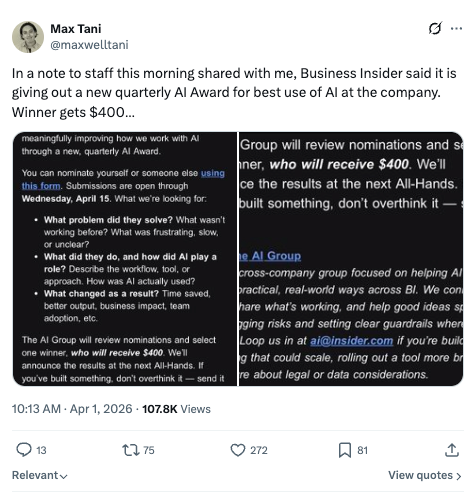
Business Insider is offering a carrot – a $400 quarterly award – to encourage AI adoption. It comes at the very moment when journalists, including staffers at The New York Times, are demanding a seat at the table on how AI gets used in their newsrooms.
EVENTS HORIZON
Where the AI & News Conversation Will Take Center Stage
WAN-IFRA World News Congress in Marseille, France – June 1-3