
 Facebook
 Twitter
 LinkedIn
 Email
EmailIn this issue
- A 150-year-old Broadcaster Bets Its Future on AI: E.W. Scripps is remaking its stations into an “AI-powered broadcast journalism company.
- Inside Politico’s AI Strategy: Francesca Barber tells Aspen Digital how one of Washington’s pioneering newsrooms is transforming for the AI and agentic era.
- Scanning for Signals: A newsroom revolt over a Palantir deal, AI helped Pulitzer Prize winners dig deeper, and AI agents help break a story.
Sign-up to receive future issues in your inbox 👉
Subscribe below
The big picture
The strategic question every publisher is wrestling with right now
A Big Broadcaster Places Its Bet on AI
When E.W. Scripps told Wall Street it would remake its local stations into an “AI-powered broadcast journalism company,” the company publicly attached real numbers to a shift the rest of the industry has mostly kept behind closed doors. During its second quarter earnings call earlier this month, CEO Adam Symson said the nearly 150-year-old media company had eliminated more than 500 jobs and open roles, representing about 12% of its workforce, as it leans into AI-powered automation. The restructuring is expected to save roughly $100 million a year and investors cheered the move. The company’s shares rose more than 20% on the news even as its earnings were below Wall Street’s estimates. Scripps is betting AI savings can offset declining local TV ad sales. The harder question: can the company do that without diluting the trust that is a core asset of local news?
Why This Matters
Scripps is perhaps the clearest case yet of a major US broadcaster rebuilding its newsrooms around AI instead of bolting a few tools into existing workflows. The transformation is happening as the economics of local TV keep deteriorating in the face of cord-cutting and declining ad dollars and while AI across the industry moves from experimentation to integration. What makes Scripps a bellwether is the timing: the markets are rewarding the cost cuts now well before the results are apparent and audiences have had a chance to judge what the changes do to the journalism itself. While some local journalists contend this will ultimately impact human-produced journalism, Symson insists quality will remain: “We are not wavering on our commitment to quality journalism,” he told analysts while the company says they want to increase the number of reporters and expand local coverage, not pull back on news.
What’s Actually Happening
- A rebuild, not an add-on. Symson positioned the changes as a “revolution” in how Scripps produces local news, one tied to its shift toward a 24-hour streaming model. The company is using AI to turn broadcast scripts into web-friendly formats, run cloud-based production, and to help organize and tailor the rundown of local market streaming newscasts. The AI automation so far is aimed at the production pipeline, not the anchor desk – at least for now.
- The guardrails in place today. Scripps bars staff from using generative AI to write scripts or stories from scratch or to create photorealistic images, and an internal AI governance committee is vetting new use cases against a stated benchmark of public trust.
- A sector-wide shift. Scripps is not alone in its thinking. Sinclair has tested real-time AI translation of newscasts into Spanish. Meanwhile, the local TV sector is consolidating fast: Nexstar’s $6.2 billion acquisition of Tegna closed in March (though the merger is hung-up in litigation) while the FCC has moved to eliminate the local TV ownership cap which portends even more consolidation. Scale and AI automation are two levers broadcasters are eyeing as essential to their future.
- The synthetic anchor may be next. For now, the AI transition is focused on production, not on-air talent, but the frontier is already visible. Days after Scripps’ announcement, an AI startup launched what it claimed is the first AI news network streaming around the clock on X, with synthetic news anchors reading the news.
What to Watch Next
- Whether Scripps savings actually materialize, and whether the viability of news itself, including ratings, output and audience trust, hold-up in the midst of dramatic change.
- Whether rivals like Nexstar, Gray and Sinclair answer with AI-first restructurings of their own.
- How far automation moves from back-end production into on-air presentation, and how clearly that is disclosed to viewers.
- Whether AI-labeling rules reach broadcast, as state-level bills on AI-generated content keep advancing.
Now Available:
Platforms, Publishers and the Future of News
In last month’s edition of Signal & Trust, we previewed our Silicon Valley convening of senior leaders from news and the major AI platforms. The full write-up is now available – a candid account of more than 30 executives in one room working through what’s breaking the information ecosystem, and what might fix it.
signal scan
A curated round-up of how AI is reshaping news – and trust
New York Times Tests Out AI-generated Search Summaries
The Times is reportedly moving to test AI-generated story summaries, a move that has opened a rift with its editorial union.
Source: Semafor
USA Today Co. Unions Call on the Company to Cut Ties with Palantir
Journalists from across 31 USA Today Company newsrooms say the deal poses an inherent conflict of interest – and threatens reader online safety and trust in the company.
Source: Poynter
From Guidelines to Architecture: How Newsrooms Are Rethinking AI Governance
As “keep a human in the loop” strains under volume of change, media managers from thirteen countries say they’re being forced to move AI governance from simple guidelines into systems.
Source: Reuters Institute
The Arena Group is Renaming Itself Paradium.ai and Its Revenue Just Halved
The publisher of The Street and Men’s Journal is rebranding and pivoting to an “asset-light” AI model as it responds to a steep revenue collapse.
Source: The Next Web
Cloudflare says Bot Blocking is Fuelling Publisher AI Deals
The company’s chief strategy officer says blocking AI crawlers is creating scarcity and leverage for publishers – including local and niche content providers – to negotiate from a position of strength.
Source: Press Gazette
➕ Quick Hits: The company behind Claude plans to fingerprint its AI-generated text (link) … The paper Alexander Hamilton founded now has an AI named after him (link) … Full disclosure from Pulitzer prize awardees: We used AI (link) … 200 AI-generated local news sites disappear in a blink (link) … Oh lord, AI reporters are actually breaking big news (link).
DEEP DIVES
➡️ Read: Holding the Line: Authentication, Verification, and the Fight for Facts in the AI Age
(Source: Center for Information Technology Policy)
➡️ Watch: Eli Pariser On The End Of The Feed & How AI Will Change Your Morning Routine
(Source: Semafor)
➡️ Listen: When AI Grandmas Go Viral, What Even Is Reality Anymore?
(Source: The Wall Street Journal)
Data point
An AI and News trend visualized
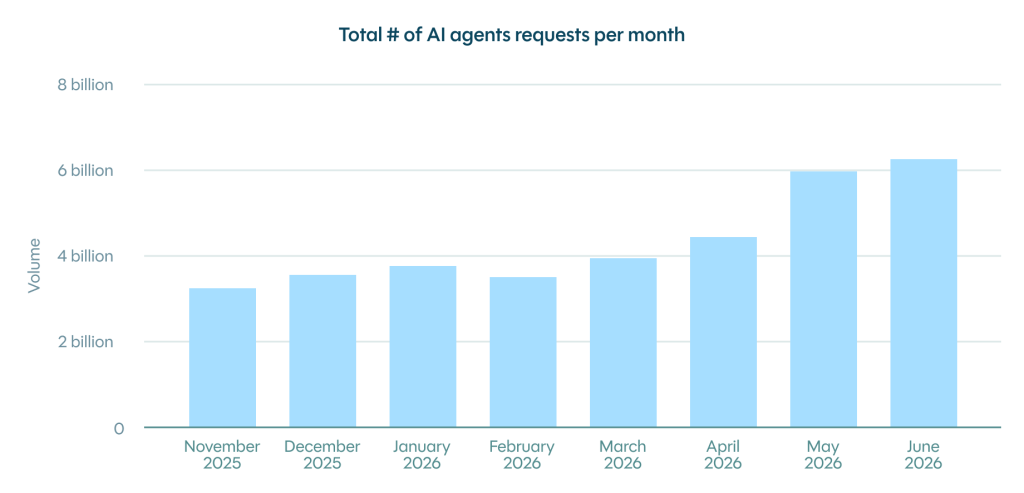
AI agents are now swarming websites, forcing news publishers to adapt. “We’re entering a new phase of the AI web,” DataDome VP Jérôme Segura told Digiday. “As AI traffic becomes more persistent, publishers need to set guidelines for crawling and indexing like they have been doing for Google. It’s imperative to understand which agents’ access content, how often, and what they receive in return.”
Primary Sources
How industry leaders are thinking about AI, trust and what comes next

“AI gives us a way to turn our journalism and editorial judgment into structured intelligence at a scale that was previously impractical. We can serve our audience that data, build new proprietary datasets, and use what we know about our own users to customize their experience with Politico.”
-Francesca Barber, Executive Vice President of Product, Audience and AI, Politico
Politico is betting that as commodity information proliferates, original facts and proprietary data only grow more valuable. Francesca Barber, Politico’s Executive Vice President of Product, Audience and AI, speaks with Aspen Digital about that bet, and what agentic AI could mean for how news gets produced and consumed. This discussion has been edited for clarity and length.
Aspen Digital: Your career has moved across journalism, product, and technology — the New York Times, Google, a travel startup, and now leading AI and product strategy at Politico. How does that diverse background shape the way you think about what a news organization needs today?
Francesca Barber: The common thread across my career has been sitting at the intersection of product and media. That is essentially the job I do now for Politico, overseeing product, design, audience, and AI. It comes down to knowing how to leverage technology and keep pace with innovation while staying grounded in the mission of journalism. For me, that mission is the responsibility of delivering original reporting and facts that people and institutions can act on.
My background in Silicon Valley is incredibly useful right now: not only do I have relationships with many of the innovators and disruptors who are sharing their insights and experiences with me, but I also feel I’m getting to go back to my old instincts of building and experimenting.
Aspen Digital: When Politico announced your expanded role last year, it made clear the stakes for the company were high: “AI is reshaping how professionals seek, filter, and act on information.” That’s a different value proposition than most news organizations. How does serving a professional policy audience change how AI innovation gets applied and what it has to deliver?
Francesca Barber: Politico is different from most news organizations in that not only do we have readers who are hobbyists, but a lot of our paying Politico Pro subscribers rely on us for their daily decision-making at work. That undoubtedly influences our AI vision. It means we must provide insightful, accurate, and essential information and data.
For me, the most exciting part of this moment is that AI is all about data, and we are a data intelligence and journalism business. Internally, we have the opportunity to make faster decisions and build more efficient workflows, and that is important. But the bigger opportunity is for our readers, subscribers, and clients, who need our journalism and data throughout the day to make decisions for their jobs. In this context, data means the public record like hearings and filings, and, critically, the proprietary intelligence our reporters generate as a byproduct of their reporting. Take Influence, our daily read on who and what is moving where across the policy world: we can turn that journalism into a living database of people and organizations, linked to public datasets, so AI surfaces signals and patterns competitors cannot see. AI gives us a way to turn our journalism and editorial judgment into structured intelligence at a scale that was previously impractical. We can serve our audience that data, build new proprietary datasets, and use what we know about our own users to customize their experience with Politico.
Aspen Digital: You were given an explicit mandate from Politico leadership: to empower “every reporter, editor, and publishing professional to be more effective and creative.” One year later, what have you been able to develop and deploy to deliver on that – and what challenges have you encountered?
Francesca Barber: Rather than just asking questions of a chatbot, our reporters and editors are spending time thinking deeply about what problems AI can solve for them and then, ultimately, building the solutions themselves.
We launched a Newsroom Innovation Hub this summer to make that systematic. The Hub builds AI-powered workflows and tools that change how our newsroom reports, edits, and publishes. Since June, the Hub has also been running hackathons that turn new AI capabilities into practical workflows. In this process, we have built more than 15 prototypes and more than 10 working tools. Some of my favorite moments have been watching people who had never used AI create a working tool in a single session, then leave excited to keep experimenting or even share what they built with colleagues.
Our Brussels Playbook is a good example. In one session the team built four tools: one assembles the next day’s calendar and news into a Slack briefing, another checks names and job titles in copy with supporting sources, and two monitor EU sources in the background and alert the team when something relevant lands, like new European Commission documents. Less time is spent on repetitive gathering and checking, and that means more time can be spent on original and distinctive reporting.
Aspen Digital: Politico Pro has tens of thousands of subscribers who rely on it for policy intelligence. But AI tools like ChatGPT and Claude can, in theory, now answer many of the same questions your subscribers might previously have relied on Politico to deliver. Are you seeing audience behavior shift in that direction?
Francesca Barber: Many of the data sources on Politico Pro are not publicly accessible, so a general AI tool cannot reproduce them. More fundamentally, raw public data and AI alone can never match what journalists gather. Our value comes from Politico defining the journalistic question, identifying the right material, and structuring it in a useful way. AI makes that feasible at scale, and we’re taking advantage of that. But the intelligence itself remains a product of human judgment, which is why a data-only competitor cannot easily replicate it.
For example, in our mandatory detention investigation, AI helped us extract and standardize information from more than 13,000 court rulings, turning fragmented public records into a proprietary dataset that powered both a major investigation and a searchable resource. We leveraged AI, paired it with our journalistic judgment, and produced reporting nobody else had. That’s not accessible through AI platforms.
At the same time, we are thinking about how to meet subscribers where they are. And yes, in some places, they are moving from destination habits to workflow integration, and they want trusted, citable intelligence inside the tools they already use. This has been particularly true of our European subscribers. So rather than fight that shift, we are working to deliver Politico journalism and data directly into those workflows.
Aspen Digital: Agentic AI – systems that act autonomously on a user’s behalf, rather than simply answering questions – may be the next major disruption for news organizations. How do you expect it to change the way news is consumed, and the way it’s produced?
Francesca Barber: This is one of the most exciting moments in my career – and I really believe, if we maintain our mission and sense of focus, we can figure out how these new technological changes open up a whole new world for the media. Our industry creates original facts and data sets. That is a scarcity in a world that is filled with commodity information. So there is a real opportunity for us to think about how to leverage that, reimagine our formats, and experiment with new ways to deliver essential information.
Think about how consumer habits have evolved. For a long time we only read the news. Then we listened to it, then we watched it. Now, on top of all of that, people also ask, create, and build. Our job is to meet users wherever they are, give them flexible ways to engage, and opportunities to continue to evolve their habits. There is real value in an editorially curated media experience, and there is real value in customization, because everything is about to get hyper-niche now that anyone can build something for themselves.
IN THE FEED
One share worth a closer 👀

Tech journalist Sam Gregory unpacks how Google nearly turned Google Earth — long a trusted source of visual evidence for journalists — into a generator of plausible fakes, and undermined the verification infrastructure newsrooms depend on.