
 Facebook
 Twitter
 LinkedIn
 Email
EmailIn this issue
- Platforms and Publishers, in One Room: At an Aspen Digital convening, leaders from publishing and tech name what’s blocking progress between the two industries and where collaboration might take root.
- Germany Puts AI Search Under Media Law: A German regulator says Google’s AI Overviews and Perplexity fall under national media law, treating their AI-generated answers as their own content..
- The Atlantic CEO on the Post-Traffic Web: Nicholas Thompson tells Aspen Digital why quality referrals, attribution and human audience matter more than clicks.
Sign-up to receive future issues in your inbox 👉
Subscribe below
The big picture
The strategic question every publisher is wrestling with right now
Platforms and Publishers, in One Room
Just weeks after the Reuters Institute’s 2026 Digital News Report found social and video overtaking news websites as a primary gateway to news — and trust at 37% globally, the lowest since the institute began tracking it — Aspen Digital brought publisher and platform leaders together in Silicon Valley to imagine a different future for the news. Aspen Digital Executive Director Vivian Schiller opened the day with a blunt premise: the current dynamic is unsustainable. A healthy information system, she argued, is a shared responsibility.
The discussion was held under a modified Chatham House Rule: comments could be used publicly, while named attribution required the speaker’s permission.
The Diagnosis
For publishers, the core issue was the value exchange. “Original reporting is essential for society and for democracy, and it is also essential to the functioning of these AI systems,” said Kevin Delaney, editor-in-chief of The San Francisco Standard. “So if we don’t solve the economic issue, we undermine the very inputs the systems depend on.” Francesca Barber, executive vice president of Product, AI and Audience at POLITICO, identified a deeper problem: journalism reveals facts, but legal and commercial systems do not know how to value that work. “Copyright protects expression, not underlying facts,” she said. “So we know facts are valuable, but the available frameworks don’t line up well with that reality.”
Tom Rubin, Chief of Intellectual Property and Content at OpenAI — speaking for himself, not the company — highlighted the importance of news organizations and put the stakes plainly: “The lack of adequate reporting would be existential for society.” He also pointed out that the disruption and disintermediation of news became an issue years ago with the advent of the internet, search and social media, long before AI.
A second technology-sector participant pointed to a less visible obstacle: internal prioritization. When technology companies allocate scarce engineering resources across competing priorities, the participant argued, “taking on this challenge (of ensuring quality information) is not emerging as important enough.”
What Progress Requires
One participant challenged the room’s starting assumption: “Why are we so stuck in the question ‘why aren’t the tech companies doing more to help the journalism industry?’… Instead of lamenting the loss of everything, why doesn’t the industry figure out how it can innovate and regain its hold on news audiences?”
Publishers responded with a request for data. “What would really matter is more data transparency around what you are seeing, because we are operating in the dark here,” said Kristina Heitmann, chief revenue officer at the Associated Press. Rebecca Grossman-Cohen, head of strategic partnerships and chief of staff to the CEO at The New York Times, described what publishers would build with it: “We want users to have very rich experiences in [frontier AI chatbots], and then come to the New York Times.”
Several technology-sector participants, in turn, asked publishers to be more specific about what’s needed. As one participant put it, the dialogue has not focused enough on how publishers themselves need to evolve to “seize back the audience and the experience. Another was more direct about the economics, arguing that demand for paid news content may not be sufficient to support every publisher.
What’s Needed Next
The room did not settle on a single model for a healthier information system. It did identify four places to start:
- User research into how people seek information inside AI systems — including local information such as public services that users might not necessarily define as “news.”
- Data sharing that shows which queries are answered with original publisher content, how it surfaces, and whether readers go deeper.
- Product collaboration built around specialized information products and workflows, versus a single licensing model for all news.
- Branded experiences inside AI systems such as visible publisher identity, subscription authentication, and pathways back that preserve attribution and support lasting audience relationships.
What to Watch
- Whether data sharing moves from a publisher wishlist to a working arrangement — and what platforms prove willing to disclose.
- Whether publishers and platforms identify specific products, user experiences or business models to test together.
- Whether subscription portability or authenticated publisher experiences get tested inside an AI product, and on what terms.
Aspen Digital will publish a fuller recap of the Platforms, Publishers and the Future of News roundtable in the coming weeks.
signal scan
A curated round-up of how AI is reshaping news – and trust
Cloudflare Will Block AI Training Crawlers by Default on Ad-Supported Sites
Starting Sept. 15, Cloudflare will block AI training and agent crawlers by default on pages carrying ads while leaving search indexing alone — pressuring Google, Apple and Microsoft to separate the two if they want continued access to much of the web.
Source: The Media CoPilot
The Associated Press Joins the SPUR Coalition as Founding Member
AP becomes the first US founding member of SPUR, whose telemetry standard would show publishers not just when AI systems take their content, but what happens to it afterward.
Source: InPublishing
USA Today Company CEO Mike Reed: Google’s Search Model Is Dead
USA Today Co. is prepared to delist from Google within six to 12 months, applying to Google the same rule it applies to every other crawler: licensees get the content, everyone else gets blocked.
Source: The Rebooting
A Quiet Shift in How Americans Perceive Local News
New Pew-Knight data suggests local news is losing the bipartisan goodwill that long insulated it from the polarization battering national media.
Source: Nieman Lab
‘Travesty’ if Publishers Don’t Take Up Chance to Opt Out of Google AI Overviews
Publishing leaders at an industry summit were told it would be a “travesty” if none of them used the AI Overviews opt-out won from UK regulators, a control the industry fought for and has yet to exercise.
Source: Press Gazette
German Media Regulator Says Google’s AI Overviews Subject to German Media Law
Germany’s state media authorities ruled that AI summaries and chatbot answers from Google and Perplexity count as content the providers create themselves, not third-party material they merely display.
Source: Reuters
➕ Quick Hits: A news aggregation pioneer is now in the originals business (link) … June scoreboard: 90% of top newsbrands take a fall (link) … For publishers it’s fewer clicks – and fewer ads (link)… (July 14) Content is going liquid whether publishers like it or not (link).
DEEP DIVES
➡️ Github: Data Journalist Agent: Transforming Data into Verifiable Multimodal Stories
(Source: University of Oxford and Stanford University)
➡️ Video: Leading Through Disruption with Financial Times CEO Jon Slade
(Source: FT Strategies)
➡️ Podcast: “We’re in a Race Against Time,” Joe Kahn on Running the New York Times in an Age of AI Slop (Source: Channels with Peter Kafka)
Primary Sources
How industry leaders are thinking about AI, trust and what comes next

“I’m starting to worry about what will happen to social media referrals if those ecosystems start to collapse as it becomes harder and harder – and perhaps eventually impossible – to tell who is human and who is a bot. What will be the point of X or Threads if you have no idea who is who?.”
-Nicholas Thompson, CEO of The Atlantic
Nicholas Thompson, CEO of The Atlantic, spoke with Aspen Digital about why subscriptions from search have held up even as overall search traffic declines, why attribution matters more than licensing checks, and what publishers should build for a web divided between humans and bots. This discussion has been edited for clarity and length.
Aspen Digital: The Atlantic formed an AI task force right after ChatGPT launched. Three years in, what has that group been working on, and what concrete changes – whether internal, external or both – can you point to as a result?
Nicholas Thompson: The first task of the task force was to analyze how much our search traffic would be at risk as AI search took over, and how we should change our strategy in anticipation. Eventually, we merged our group into one that meets less frequently and evaluates AI licensing opportunities and partnerships. I don’t want to go into our full strategy for what we’ve done, but one change that I think was good was to reorient our entire audience strategy away from “traffic” in general and toward “quality traffic,” meaning referrals from sites that tend to have a high subscription propensity. I’ll also note a small, counter-intuitive change, which was to increase the number of print editions we publish. AI is unlikely to disrupt the US Postal Service.
Aspen Digital: Publishers expect search traffic to fall by more than 40% over the next three years, according to the Reuters’ 2026 predictions report. You’ve acknowledged The Atlantic has not figured out the replacement model yet. What steps are you taking to mitigate against that expected decline?
Nicholas Thompson: We care less about the decline in search traffic than we do about a decline in subscribers coming from search. And to my great surprise, that number has not yet gone down. Google is still sending us the search queries that lead to subscriptions, like “Atlantic coverage of Iran,” even as we lose queries that don’t lead to many subscriptions, like “What happened in Iran today?”
We will get hit eventually, but it won’t be as bad as many people think. Right now, I’m starting to worry about what will happen to social media referrals if those ecosystems start to collapse as it becomes harder and harder—and perhaps eventually impossible—to tell who is human and who is a bot. What will be the point of X or Threads if you have no idea who is who? Social media will, I think, undergo a fundamental change in the next couple of years and we need to make sure we’re prepared for that too.
Aspen Digital: You’ve called generative AI “the best editorial tool we’ve ever had” and yet expressed worry about AI’s impact on business models. Where’s the balance between accelerating AI use and applying the breaks?
Nicholas Thompson: Yes, it’s an amazing tool! I don’t work in editorial anymore, but I love, on the side and for my own amusement, setting up agents, loops of agents, and agent farms to investigate old mysteries that stumped me back when I was a reporter. It’s fun and the tools are astonishingly powerful if used right.
As for the brakes, we don’t have any control over them. The people who can press those pedals work elsewhere – like at the labs or in government. Our job is to use the tools in the best, most ethical ways possible and to understand, as well as we can, all the changes that the technology will bring. My position has always been that you should study the tools as much as possible, and that you should use them in ethical ways that help you. And, at the same time, you should prepare for the ways that they could turn your business upside down.
Aspen Digital: In your Nieman prediction for 2026 you argued that “a healthy publishing industry is good for the AI industry.” But licensing values are falling and revenue sharing by AI companies does not look like it will be on the table. What will it take to get AI companies to actually pay news publishers for the value of their content?
Nicholas Thompson: AI companies should pay to license content, and I’m going to work to line up every fair deal that I can. But that’s not the most important thing that needs to happen. One-time payments are good but secondary. The real goal is for the models to develop fair systems of attribution and fair systems where they send substantial readers back to content creators. Helping get that to happen is an essential goal for me.
How do we do that? Well, we have to engage with the labs, the platforms, and the startups. We have to make sure that our content is hard to access by bots. We have to make sure that legislators understand the situation. And we have to offer actual solutions to the AI industry. We have a terrific partnership with OpenAI where we talk about these issues, and I work closely with a number of people across the tech industry. There are lots of folks at the big tech companies who would like the media industry to stop reporting on them and to die a gnarly death; and there are a lot of folks who would like the media to survive and thrive, and who know that it’s partly their role to make that happen.
Aspen Digital: You’ve explored “pay-per-scrape” alongside licensing deals. But OpenAI has ruled out paying publishers per crawl. If the largest AI company won’t pay per crawl, is that model dead—or does it require regulatory intervention to have teeth?
Nicholas Thompson: I don’t think the idea is dead. I highly suspect, in fact, as we move into a world in which web traffic falls in three big categories—bot scraping, agentic crawling, and human viewing—that pay-per-crawl might become a standard in the middle category. I also think that there will be a system of micropayments that work with agentic middlemen and interesting new ways that companies that power agents will provide compensation to publishers who provide content for those agents. See for example the partnership we just announced with Parallel, which uses a smart system of “Shapley Math” to attribute payments to sources based on the value they provide. Their agents create answers for their users, and then they work backwards to determine how much each data source contributed the answer, and they pay based on that.
Aspen Digital: You’ve said that The Atlantic is “100% human-created and verified,” yet you advocate for AI tools in research, translation, and customer service. How do you enforce that boundary, and who decides when it’s been crossed?
Nicholas Thompson: I have nothing to do with Atlantic editorial decisions, and I’m blessed to have a partner, Jeff Goldberg, whose judgment I trust absolutely and completely. So Jeff enforces those boundaries and determines them. I will say that he and I do very much agree that AI should never be used to write a single word of a single story. We’re a magazine founded by humanists after all.
I should add that on the business and engineering side and the areas where I do have authority—like how we do customer service, prepare advertising decks, optimize paid marketing, set product strategy, move Jira tickets along more efficiently, and so on—I do absolutely want us to be exploring every way that AI can make us more efficient and creative.
Aspen Digital: The vision for AI in 2026 is that it becomes more agentic, in effect a “personal super assistant” that pushes personalized news through products before users even ask. You’ve described a future with “two webs”—one for humans, one for bots. If AI agents are curating and delivering news proactively, does The Atlantic’s direct relationship with readers survive? What are you building now to stay essential in that world?
Nicholas Thompson: We will have to build as many direct connections to human readers as we can: through our app, our newsletters, our homepage, our owned social feeds, curated spaces like Apple News, authenticated community forums, and more. And then we’ll have to build a monetization strategy for the agentic web, so that we can make money from advertising, subscriptions, and licensing. Maybe I can be optimistic and say that the number of ways we can make money and support our journalism is just going to increase!
Data point
An AI and News trend visualized
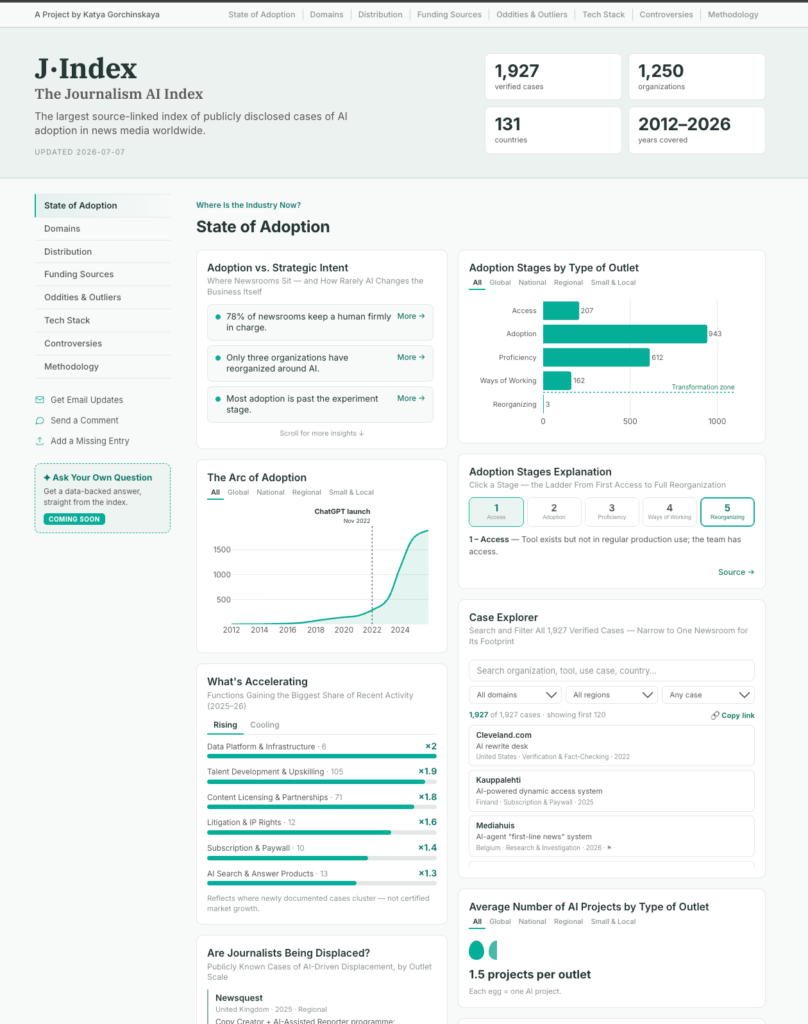
J·Index catalogs 1,900-plus verified cases of newsroom AI adoption across 130-plus countries, each with a live source link. Most involve augmentation, not replacement. Only a small number of outlets are reorganizing the business around AI.