

 Facebook
 Twitter
 LinkedIn
 Email
EmailIn this issue
- The AI Generation and News: AI is shifting not only how journalism is produced, but how the next generation finds, consumes and trusts news. Can publishers adapt?
- Same Gatekeepers, New Tollbooths: A landmark new report finds that the AI content licensing market is repeating the same dynamics that strained publishers during the social and search era.
- After the Blue Link: Google is replacing the ranked list of links with AI agents and conversational answers in Search, marking the end of the referral era for publishers.
Sign-up to receive future issues in your inbox 👉
Subscribe below
The big picture
The strategic question every publisher is wrestling with right now
AI and Next Gen News Consumers: A Trust Opportunity – If Publishers Take It
Publishers have spent years worrying about young audiences lost to TikTok, YouTube creators and algorithms designed to maximize scrolling. And now AI chatbots are delivering them news without sending the readers to the site where the reporting originates. The industry’s diagnosis about each new digital disruption has been consistent and dire: Young people are distracted, platform-addicted and indifferent to serious journalism.
But a wave of recent research paints a more complicated picture of how AI is reshaping how younger audiences consume news – at least at this moment. The studies suggest that the industry may have had this wrong before AI arrived and may be in danger of getting it wrong again.
Why This Matters and What’s Actually Happening
According to the Next Gen News 2 report, 65% of younger news consumers say they value news for personal and professional development. More than half consume news at least daily, even as they feel overwhelmed by it. A new European Commission study finds 94% of 11-to-17 year olds already use AI chatbots habitually as everyday companions for learning and decision-making. The research suggests next-gen audiences aren’t abandoning journalism for chatbots – they’re looking for credible answers, and reaching for whatever source delivers them.
Two behaviors are emerging which should prompt a rethink inside the industry.
- The flood of synthetic low-quality content may be creating a backlash that favors quality news providers, if they are positioned to capitalize on it. The appetite for trusted, verified information doesn’t disappear in an AI-saturated environment, arguably it grows. “The question isn’t ‘how do we win the content wars on the platforms designed to crush us?’” Adam Harder, the founder of InPress, a social first platform featuring vetted journalism, tells Aspen Digital. “The question is: What value can our journalism create in people’s lives that isn’t captured at the moment of reading?”
- Trust among young people is less about institutional brands and more about individual news producers who show their work. Lamberto Lambertini, who helped author the Next Gen News 2 report from FT Strategies and Knight Lab, identifies three factors young people weigh when deciding to trust a news source: whether the person has direct experience or expertise in what they’re covering; whether they present news in language and formats that feel familiar and accessible; and whether they’re upfront about their perspective and why they cover what they cover.. “News is a social behavior,” Lamberto tells Aspen Digital. “Even young people expect it to help them understand their place in the world – and they trust the people who are transparent about how they know what they know.”
What to Watch Next
- Whether more major publisher moves away producing more content and towards building deeper audience trust
- Whether next-gen news products are designed around what younger audiences need and desire – or are just retrofitted from legacy products. As Harder puts it: “The journalists and publishers who win the next decade … will be the ones who stop asking why younger audiences aren’t engaging with their content and start asking what they could build around their content that audiences would actually want in their lives.”
- Whether editorial transparency – disclosing sourcing, methods, and AI use – becomes a market signal audiences act on
🔎 GO DEEPER: The Reuters Institute’s new report Understanding Young Audiences at a Time of Rapid Change is a comprehensive look at how 18-to-24-year-olds are finding, trusting and engaging with news – and what journalists can do about it.
signal scan
A curated round-up of how AI is reshaping news – and trust
Google Search As You Know Is Over
Google declares the end of the “ten blue links” era, rolling out AI answers, agentic search and interactive experiences to its 2.5 billion search users, free of charge. For publishers, it’s another sign the referral era is ending.
Source: TechCrunch
Major Chatbots Miss the Mark on News
A new benchmarking tool from Forum AI called NewsBench shows AI chatbots vary widely on how accurately and fairly they represent news and current events.
Source: Bloomberg Technology on YouTube
Landmark New Report Warns That A Flawed AI Content Market is Accelerating ‘Content Cannibalization
The same big tech firms eroding publisher traffic now control the licensing regime meant to compensate for that loss. Researchers argue that the voluntary steps being offered as fixes are a repeat of the social media era.
Creator Journalism is the Most Disruptive Shift the News Industry Has Seen, Ex-BBC News Head Says
Former BBC News CEO Deborah Turness says creator journalism is more disruptive than the digital age and social media because those shifts were about new platforms for the same journalism. “What we’re witnessing is the wholesale shift from one information ecosystem to another,” she argues.
Source: Nieman Lab
Inside the News Industry’s Efforts to Join Forces to Defend its Journalism from AI Companies
A growing number of publishers are banding together to negotiate with AI companies rather than facing them alone. Some leaders think the music industry offers a model for what needs to happen next.
Source: Reuters Institute
➕ Quick Hits: Politico’s AI rollout hits a wall – in it’s own newsroom (link) … How ChatGPT is flooding our feeds – and lives (link) … Local news says 🚫to the Internet Archive (link) … The disappearing act of a Florida fake news site (link)
Data point
An AI and News trend visualized
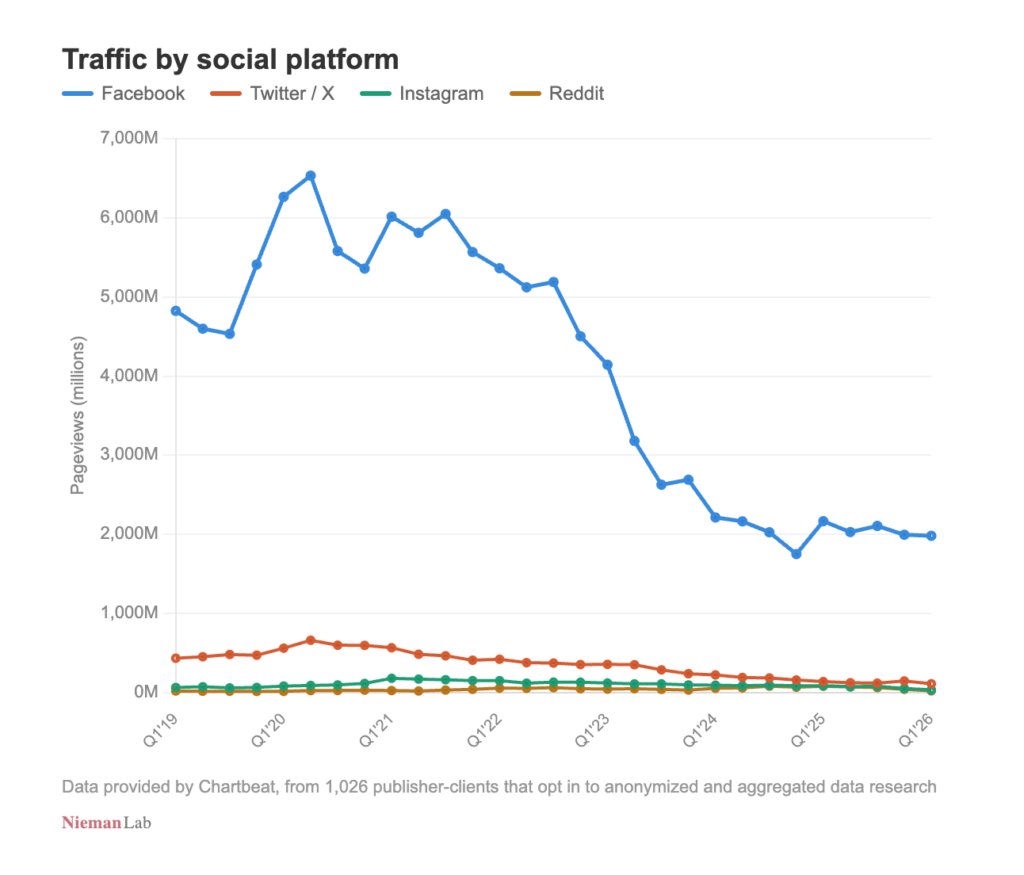
Twitter referral traffic to news publishers has fallen 70% since Elon Musk acquired the platform in 2022 and Facebook isn’t picking up the slack. Search and social, the two traffic pillars publishers built their digital businesses on, are eroding at the same time.
Primary Sources
How industry leaders are thinking about AI, trust and what comes next

“Journalists invest the time, expertise, and institutional trust required to produce high-quality information, while increasingly, platforms and AI systems intermediate, summarize, and monetize that work without returning value to its source. That’s unsustainable.”
– Katy Knight, Executive Director and President of Siegel Family Endowment
As president of the Siegel Family Endowment, one of the leading philanthropic voices shaping the future of information and democracy, Katy Knight argues that journalism isn’t an industry in decline, it’s infrastructure under stress.
Aspen Digital: Siegel Family Endowment frames journalism as social infrastructure, not just an industry. For an audience of news leaders, why does that distinction matter?
Katy Knight: It changes what you’re optimizing for. When thinking from the perspective of an industry, you might prioritize optimization for market sustainability within existing structures. If we approach it as a social infrastructure, and thus foundational to connected communities and informed democracies, you optimize for information integrity and public good, even if that requires reimagining the entire system
At Siegel, we see information broadly: traditional journalism, but also new media, libraries, archives, local collective knowledge. They’re all essential to our social fabric. Journalism is one critical piece, but not the only one. This distinction matters practically. As our colleague Gina Chu puts it: “We’re not in the business of saving journalists’ jobs; we’re not even in the business of saving journalism per se. We’re in the business of saving information in the public interest.”
For Siegel, that means creating space for field-wide conversations about the future, convening not just news executives, but also other key stakeholders in the information ecosystem – local leaders, librarians, civic technologists, next gen creators, multilingual communities, documentary filmmakers, and yes, platform companies. It means supporting experimental outlets and initiatives to develop the next generation of journalists and communicators.
When you frame journalism as part of our infrastructure, you ask different questions: How do we ensure information flows to communities that need it most? How do we sustain quality reporting when markets fail? How do we build redundancy and resilience in service of integrity?
Aspen Digital: You’ve talked about “technopragmatism” – aligning AI with real outcomes rather than either resisting change or accepting it uncritically. What does that actually look like in practice when some might contend the technology is moving faster than any institution’s capacity to evaluate it?
Katy Knight: Embedded in the question lies the problem: if AI is getting away from us, it’s not serving us. If AI is moving faster than our ability to evaluate it, then by definition it’s not serving us, and that “us” includes the people building it. The point of scaled technology should be to meet what we need, not create more tools in search of use cases. That’s not to say we shouldn’t be developing novel technologies and pushing the boundaries of possibility, but that we could stand to be more judicious about what is scaled and served up to millions of people. In practice, technopragmatism means people who see a real problem designing fit-for-purpose solutions. AI that dispatches EMTs faster. Systems that predict and adjust water and electrical flows. Tools that make public records searchable. We don’t get to these things without the rapid and experimental development that is advancing the science and technology being paired with thoughtful consideration of its best use cases.
Aspen Digital: Siegel Family Endowment has taken the position that AI is “neither poison nor panacea – it is what we make of it.” But democratic institutions, including journalism, have historically been slow to shape technology on their own terms. What would it take to change that dynamic?
Katy Knight: I think that democratic institutions were never designed to move at the pace of the technology cycle, and in many ways, that’s a good thing. Their role is not to chase every new tool and regulate it, but to create the conditions for legitimacy, accountability, and public trust, and the guardrails where necessary to prevent significant harms. The more important question, to me, is not “How do institutions move faster?” but “How do institutions become better equipped to engage with technological change on their own terms?”
Too often, the conversation frames technology as something happening to journalism, government, or education, rather than something these institutions can actively shape. That framing alone limits imagination and agency. Part of what would change the dynamic is building stronger translation layers between technical development and public institutions. We should create better technical tools for the social sector to understand and make use of emerging technology. Faster bipartisan working groups on critical tech developments. More experimentation, such as having institutions test technology on closed, small-scale platforms to understand what it actually does before encountering it at scale in the real world. We should connect public interest technologists, researchers, educators, and practitioners with leaders to ask better questions about what technology is actually for, who it serves, and what kinds of futures it enables.
Aspen Digital: AI is putting pressure on two things at the same time: the economics of journalism and the integrity of the information environment. Which of those problems concerns you more and why?
Katy Knight: I see them as entwined. The current economic structure reduces incentives to spend resources on high-quality information, and AI is accelerating that collapse. We think about information across its full chain: production, distribution, consumption, and use. Journalists invest the time, expertise, and institutional trust required to produce high-quality information, while increasingly, platforms and AI systems intermediate, summarize, and monetize that work without returning value to its source. That’s unsustainable.
Newspapers used to be the major source of information distribution. That’s evolved, first to online search engines, and then to social media, now to AI playing major roles in providing information. Yet AI isn’t inherently the problem; if designed well, it could improve distribution and user experience. People still want local news only local journalists can provide. The real issue is how value flows through the system.
On consumption, market signals matter; how and where citizens chose to consume news assigns value to information and shapes what gets produced, even if they don’t realize it. As much as I LOVE newspapers (former managing editor of The Zephyr, my school newspaper which I still have copies of in my house!), we need to pay attention to and adapt towards those signals.
Finally, use: what are people doing with information? This influences both how they consume it and what gets produced. What’s most concerning to me is that most consumers don’t realize that economics have changed. They can’t make different choices if they don’t see the problem. We need to make that more visible before they can begin to consider making different choices.
Again, our focus is on protecting and sustaining information integrity, not just preserving journalism as it previously existed. That means asking different questions: What’s a fair cost distribution for information value across production and distribution? What does an economic model for integrity actually look like? How do we structure information markets with more visibility and fairness?
Aspen Digital: For news industry readers of this newsletter, what’s the most important thing they may be underestimating about what it will take to keep the civic information ecosystem intact in an AI-driven world?
Katy Knight: Narrative. We cannot let the doomerism versus optimism argument over technology be the driving narrative structure anymore. There’s too much nuance here and we all need to be at the forefront of explaining that not participating in it anymore, even in ways we may not realize. You have agency. The future of journalism isn’t something that just happens to the industry, it will be shaped by the choices institutions, platforms, and audiences are willing to make now.
in the feed
One share worth a closer 👀
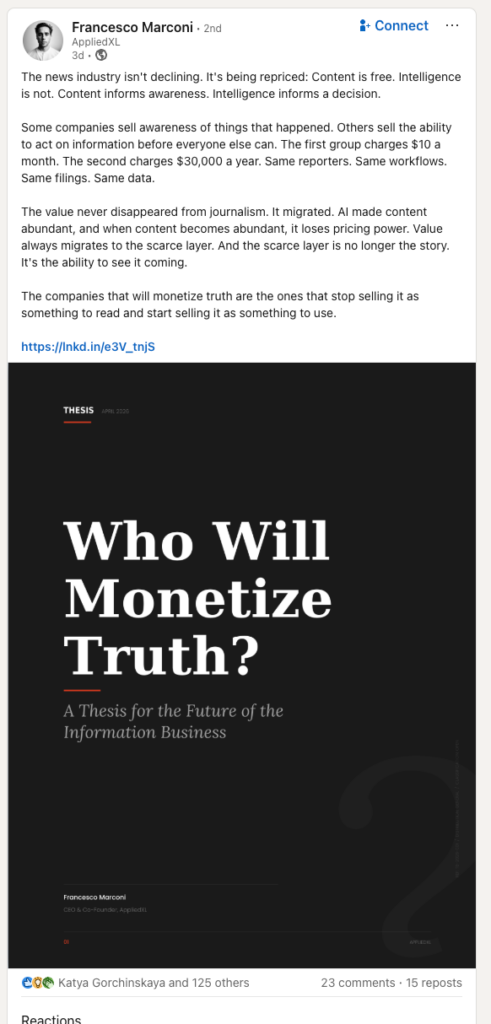
News technologist Francesco Marconi contends that the media industry is splitting into three categories: the Intelligence Business which sells reduced uncertainty and commands 30% margins; the Attention Aggregator, whose model collapses as AI reduces clicks; and the Public Good publisher, which needs a different funding model to survive.
EVENTS HORIZON
Where the AI & News Conversation Will Take Center Stage
WAN-IFRA World News Congress in Marseille, France – June 1-3
News Product Alliance Summit in Chicago, Illinois – October 21-23
INMA Media Tech & AI Week, San Francisco, California – October 21-23