

 Facebook
 Twitter
 LinkedIn
 Email
EmailIn this issue
- The AI Battle Lines Forming: A wave of newsroom unionization, a landmark arbitration ruling, and new state legislation are colliding to decide who controls AI in journalism.
- Publishers Lose Ground: The Reuters Institute’s 2026 Digital News Report finds social media and video have overtaken publishers’ own platforms as the world’s top source of news for the first time and AI chatbots are a growing part of the shift.
- The Lead Author Speaks to Aspen Digital: Jim Egan, who steered the Reuters report and once ran BBC Global News, tells Aspen Digital why people keep using AI chatbots for news even though most say they don’t fully trust them.
Sign-up to receive future issues in your inbox 👉
Subscribe below
The big picture
The strategic question every publisher is wrestling with right now
Who Sets the Rules for AI in the Newsroom?
The picket line outside ProPublica’s Lower Manhattan offices in April told a story that the industry is only now coming to terms with. Roughly 150 journalists and media workers walked out – the first strike at a major U.S. news organization where AI was a central sticking point. It wasn’t a dispute about whether AI belongs in journalism. It was about who gets to decide how it’s used, and in whose name.
That question is now playing out across newsrooms across the country and the early answers show the industry is diverging sharply.
Why This Matters and What’s Actually Happening
In November 2025, an arbitrator found that POLITICO had deployed two AI products without giving its union sufficient notice, a ruling that the journalism newsletter Nieman Lab called “one of the first major tests of an AI clause in a newsroom union contract.” By May 2026, POLITICO had decommissioned both tools, characterizing it as a “business decision” and explaining they had been superseded by newer technology and that it was instead planning on developing new AI tools.
Jon Schleuss, the president of the NewsGuild-CWA now oversees 283 union contracts, 74 of which contain AI-related language. His read on publishers resisting that language is blunt: “What they’re really saying is that publishers don’t want to give up unilateral control to do whatever they want and ignore journalists,” he told Aspen Digital. “It’s really a matter of who you trust in dealing with AI ethically: corporate executives or journalists.”
What to Watch Next
- Whether newsrooms start putting more emphasis on using AI for sourcing and verification – where Marconi says it creates real value – instead of content generation.
- Whether New York’s FAIR News Act gets signed into law and if other states follow.
- Whether more newsrooms unionize specifically over AI, versus wages or other working conditions, following the lead of the Centre Daily Times.
CORRECTION: This item has been updated to better reflect the labor arbitrator’s decision regarding POLITICO’s use of AI and to clarify and add the company’s public statements about why it stopped using the tools in question.
signal scan
A curated round-up of how AI is reshaping news – and trust
UK Plans to Give Established Media More Visibility on YouTube and TikTok
The UK wants to put trusted news at the top of your feeds. Platforms say the government is picking winners.
Source: The Guardian
This Chatbot Wants to Solve AI’s News Problem
NewsGuard, which rates the reliability of news sources, has launched a news chatbot they claim is a gold standard for the industry.
Source: CNN
Reuters 2026 Digital News Report: News Sites are the New Newspapers
The headline finding is stark: social media and video networks have overtaken news organizations’ own websites and apps as the most common way people access news worldwide. AI chatbots are still a small slice of that shift, but the report’s lead author tells Aspen Digital, the direction of travel is unmistakable. Read our interview in this month’s Primary Sources.
Source: Nieman Lab
New York Times Publisher Warns That AI Companies Are Making Choices That ‘Violate Settled Law’
In a pointed keynote, A.G. Sulzberger argues AI companies are knowingly building products on legally shaky ground and that the tech industry’s “ask forgiveness, not permission” approach could cause “a great deal of unnecessary harm.” (Watch the full keynote →)
Source: Variety
Landmark German Ruling Declares Google’s AI Overviews Are Google’s Own Words and Liable
A Munich court rules that Google is directly liable for false claims in its AI Overviews.
Source: The Decoder
➕ Quick Hits: CNN lawyers up against Perplexity (link) … US publishers tell Common Crawl: Delete everything (link) … New York wants AI to wear a name tag (link) … Turns out AI search has a Reddit problem (link)
RESEARCH ROUND-UP
➡️ FT Strategies-WAN-IFRA: Future Newsrooms Study 2026 (Source: FT Strategies & WAN-IFRA)
➡️ AI-Mediated Storytelling in a Liquid Information Ecosystem (University of Surrey, Guildford)
➡️ The Consequences of Relying on AI for Accurate News (MIT Media Lab)
Primary Sources
How industry leaders are thinking about AI, trust and what comes next

“AI is a new frontier in intermediated news consumption, but the primary accelerant today is still the broader platformisation of news, particularly the growth of social and video networks.”
– Jim Egan, Senior Research Associate, Reuters Institute; Former CEO of BBC Global News
Jim Egan, the Reuters Digital News Report’s lead author and former CEO of BBC World News, spoke with Aspen Digital about what’s actually driving platforms past publishers, the trust paradox behind chatbot use for news, and where future revenue growth can still come from. This discussion has been edited for clarity and length.
Aspen Digital: The headline finding in this year’s report is that platforms are overtaking publishers as the primary news source globally. Is AI – search overviews, chatbots, and AI-mediated feeds – the accelerant in this trend, or is something else driving it?
Jim Egan: AI is part of the story, but the data suggests it is not the main driver. The bigger structural shift is the long-running move away from direct news consumption – TV, print, radio, and publishers’ own websites and apps – towards third-party platforms, especially social media and video networks.
This year, social media and video networks became the most widely used way of accessing online news globally, used by 54% of respondents, ahead of news organisations’ own websites and apps at 51%. If AI chatbots are included, the third-party platform total rises to 56%. But weekly use of AI chatbots for news is still much smaller: 10% globally, up from 7% last year. So AI is a new frontier in intermediated news consumption, but the primary accelerant today is still the broader platformisation of news, particularly the growth of social and video networks.
That said, AI may reinforce the direction of travel. AI chatbot news use tends to be higher in countries where search, social, aggregators, and video platforms are already more widely used, and lower in countries where direct access remains popular. In that sense, AI follows the existing pattern of platformisation rather than creating it from scratch.
Aspen Digital: Your data shows trust in news at 37% globally, the lowest point you’ve recorded. The report also notes that trust in established news brands is proving “resilient.” How do you explain this seeming contradiction?
Jim Egan: The contradiction is partly resolved by distinguishing trust in news overall from trust in specific, familiar news brands. Global trust in news has fallen to 37%, down three percentage points (pp), the lowest level recorded since 2015. Trust fell significantly in 29 of the 48 markets, and by 5pp points or more in 19 markets. But in the countries where trust fell most, the reductions in overall trust were larger than changes in trust ratings for individual news brands.
This suggests that people may be reacting to a broader information environment rather than simply downgrading every established news provider. We note external factors such as political instability, divisive elections, a noisier and more fragmented information environment, and direct attacks on journalists and news organisations as likely contributors. In other words, public confidence in news can deteriorate even while some established brands remain relatively trusted.
Aspen Digital: Your report shows chatbot use for news is growing, especially among younger audiences. But your report also says trust in chatbots is low. Why are people using a source they don’t trust, and should that worry us?
Jim Egan: Globally, 20% say they trust news from AI chatbots most of the time, but among AI chatbot news users, trust is actually substantially higher. This suggests that as adoption of AI chatbots and answer engines increases trust may well go up as users become more confident in the tools’ capabilities..
But trust is not the only explanation of usage – we see a number of different reasons why people find AI chatbots useful for news and people may well value facets such as convenience, speed, explanation, summarisation, and interactivity even if they continue to have reservations about trustworthiness.
There is also some evidence of caution among users. AI chatbot users who click through from answers to queries are more likely than search or social media users to say they do so to verify the news or find out more about the source. That might suggest some users are not treating chatbot answers as a final authority.
Aspen Digital: You describe AI chatbot news users as “highly engaged news consumers.” What’s your sense as to whether this holds over time, or are we seeing early adopters before the mass market shifts?
Jim Egan: 38% of AI chatbot news users fall into what we call the “news lover” segment, compared with 22% of respondents overall. Usage is also higher among people who access news more frequently: 18% among those who consume news 10 or more times a day, compared with 7% among those who consume news once a day. AI chatbot news use is also higher among the extremely interested in news.
That points to a current user base that is particularly engaged with news, keen to experiment, and comfortable with multiple digital tools. But we don’t have sufficient data yet to see how the composition of this user base has changed, let alone to predict how it might evolve in future.
Aspen Digital: The proportion of people paying for online news is flat at 17% across the markets you surveyed. Meanwhile, direct relationships with audiences are getting harder as platforms consolidate discovery. If AI continues to reduce referral traffic and platforms increasingly answer questions without sending users anywhere, what’s the revenue pathway for news industry growth – especially for those publishers who don’t have subscription scale?
Jim Egan: There has been lots of industry research pointing to search traffic becoming fragile, platform traffic less dependable, and it is plausible that AI answer environments may reduce some forms of onward traffic. But there’s not enough evidence yet to be certain that these effects are having a direct negative impact on reader revenue models – these changes may well be principally reducing traffic to owned digital properties from users who were always relatively unlikely to convert to paying subscribers. Nevertheless, anything which impacts the ‘top of the subscription funnel’ is another headwind.
The logic suggests that for publishers wanting to build reader revenue a sensible response is to establish distinctive, high-value relationships rooted in the value of unique, distinctive content in curated branded destinations that audiences cannot easily replace with generic summaries: specialist expertise, local relevance, investigations, service journalism, strong formats, and community or membership propositions.
Aspen Digital: Last year, nearly six in ten people you surveyed globally told you that they worried about their ability to tell true from false online. With AI making synthetic content more prevalent in our feeds, is that concern going up, going down – or are audiences getting used to it?
Jim Egan: Concerns about fake news are up by 4 percentage points this year to 62% on average, with jumps of more than 5pp in 11 markets. Brazil is the only market where misinformation concern decreased, by 3 points. The data does not allow us to isolate synthetic AI content as a specific cause of the rise, we place the increase within a wider context of platformisation, falling trust, and a noisier and more fragmented information environment. Asking respondents about their awareness of synthetic AI content and its impact on their concerns about fake news and misinformation could be a great focus of next year’s research.
🎧 GO DEEPER
Jim Egan joined Brian Morrissey on The Rebooting Show to dig into one of the report’s key findings: people aren’t seeking out news products anymore. Instead, news is increasingly a feature inside other products they’re already using.
Data point
An AI and News trend visualized
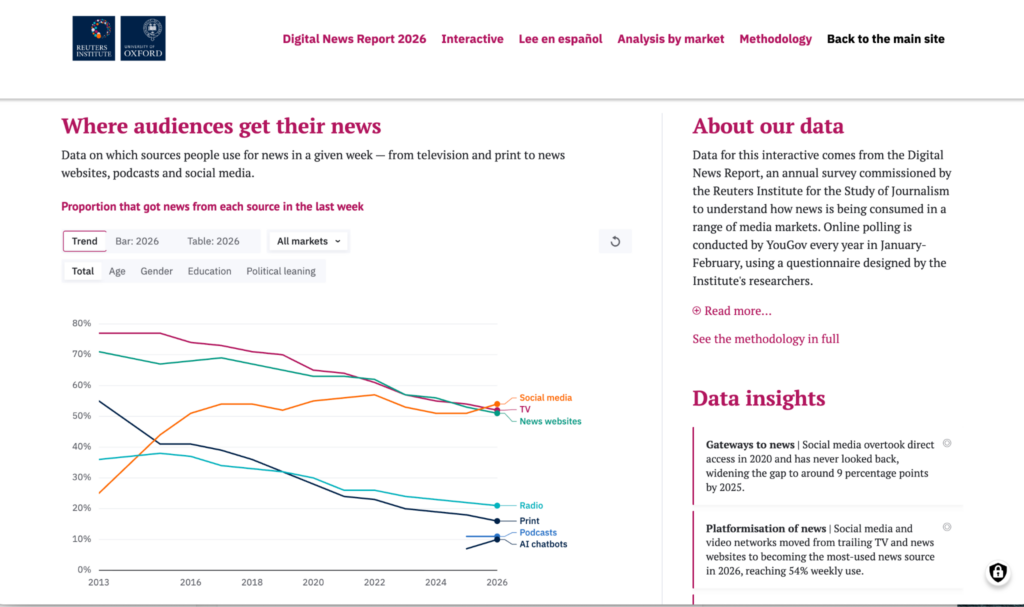
Now you can dig through the Reuters 2026 Digital News Report data yourself. A new interactive from the Reuters Institute team lets you compare 14 years of survey data, letting you build cross-market and cross-demographic charts on demand.
IN THE FEED
One share worth a closer 👀
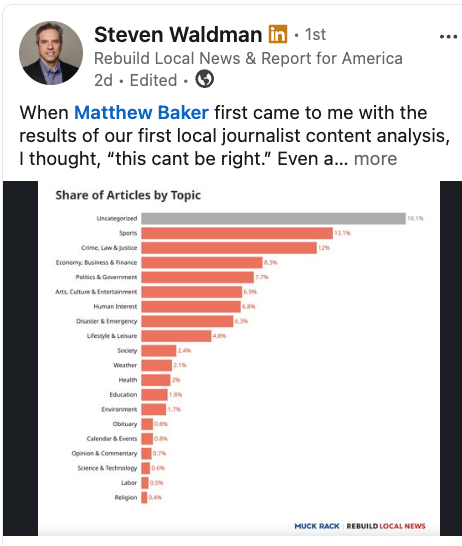
A new Muck Rack/Rebuild Local News analysis found that 51% of U.S. counties had zero local news coverage in a recent three-month stretch and reporting on education, health, and the environment was nearly non-existent. Shrinking newsrooms keep the beats that drive traffic – crime chief among them – while the rest disappear. If AI is going to reshape local news, can it be pointed at news coverage that doesn’t pay for itself?
EVENTS HORIZON
Where the AI & News Conversation Will Take Center Stage
Hacks/Hackers and ASU AI x Visual Journalism Forum in Los Angeles – August 25-26
INMA Media Innovation Week in Madrid, Spain – September 21-25
News Product Alliance Summit in Chicago, Illinois – October 21-23
INMA Media Tech & AI Week in San Francisco, California – October 21-23